
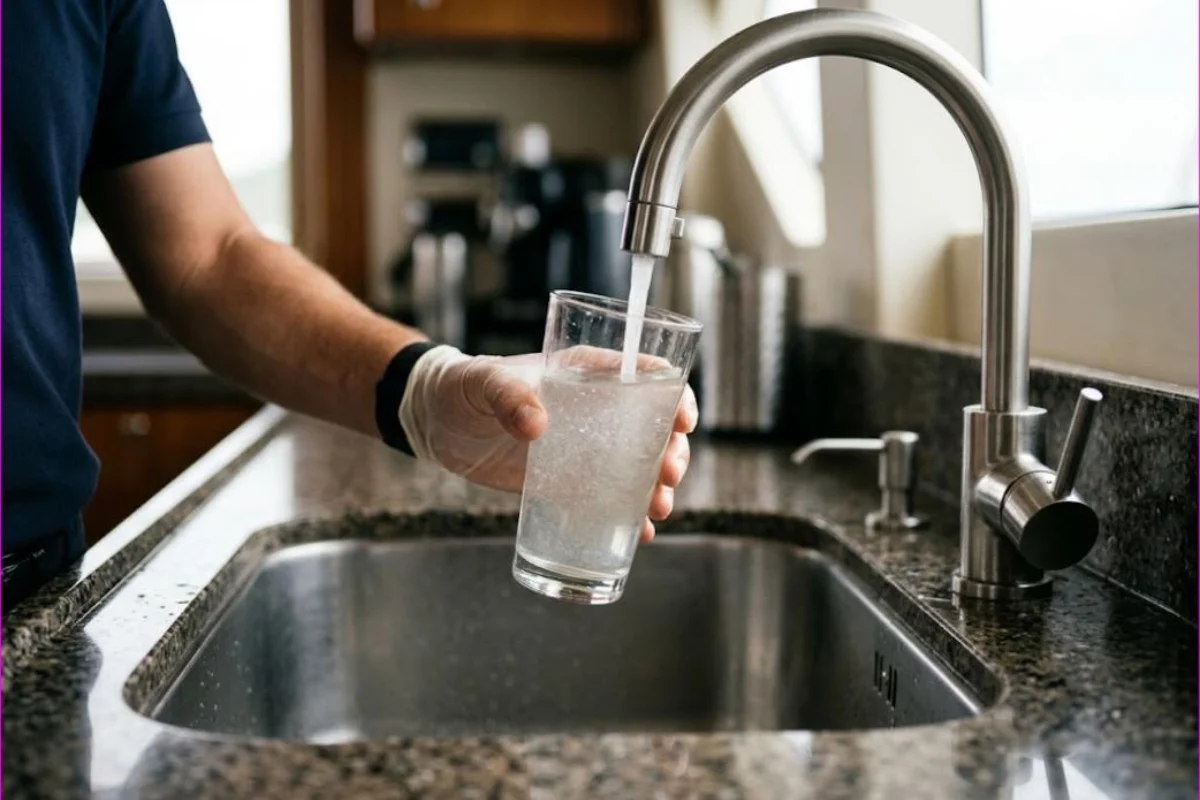

Why Is the Water on My Yacht Cloudy?
Sometimes it is only air. Sometimes it is worth a closer look.
Milky or hazy water at the tap worries guests and crew alike, but the cause ranges from harmless micro-bubbles to sediment stirred up in a tank. This guide shows a simple test to tell them apart and explains when the water should be sampled or the system cleaned.
yacht experience
“The water comes out of the tap looking milky”
Cloudy water can look similar at first glance, but it behaves differently depending on the cause.
White, milky water that clears in a minute
A glass that looks like diluted milk and then turns clear is usually full of tiny air bubbles, not dirt.
Hazy water that stays hazy
Cloudiness that does not clear while standing may indicate fine particles, known as turbidity, from the tank or the source water.
Yellow, brown or rust-coloured water
Colour can be associated with corrosion in fittings or the calorifier, or with sediment stirred up at the bottom of a tank.
Cloudy only after refilling at the quay
If the problem starts right after bunkering, the incoming water or the turbulence in the tank during filling are the first suspects.
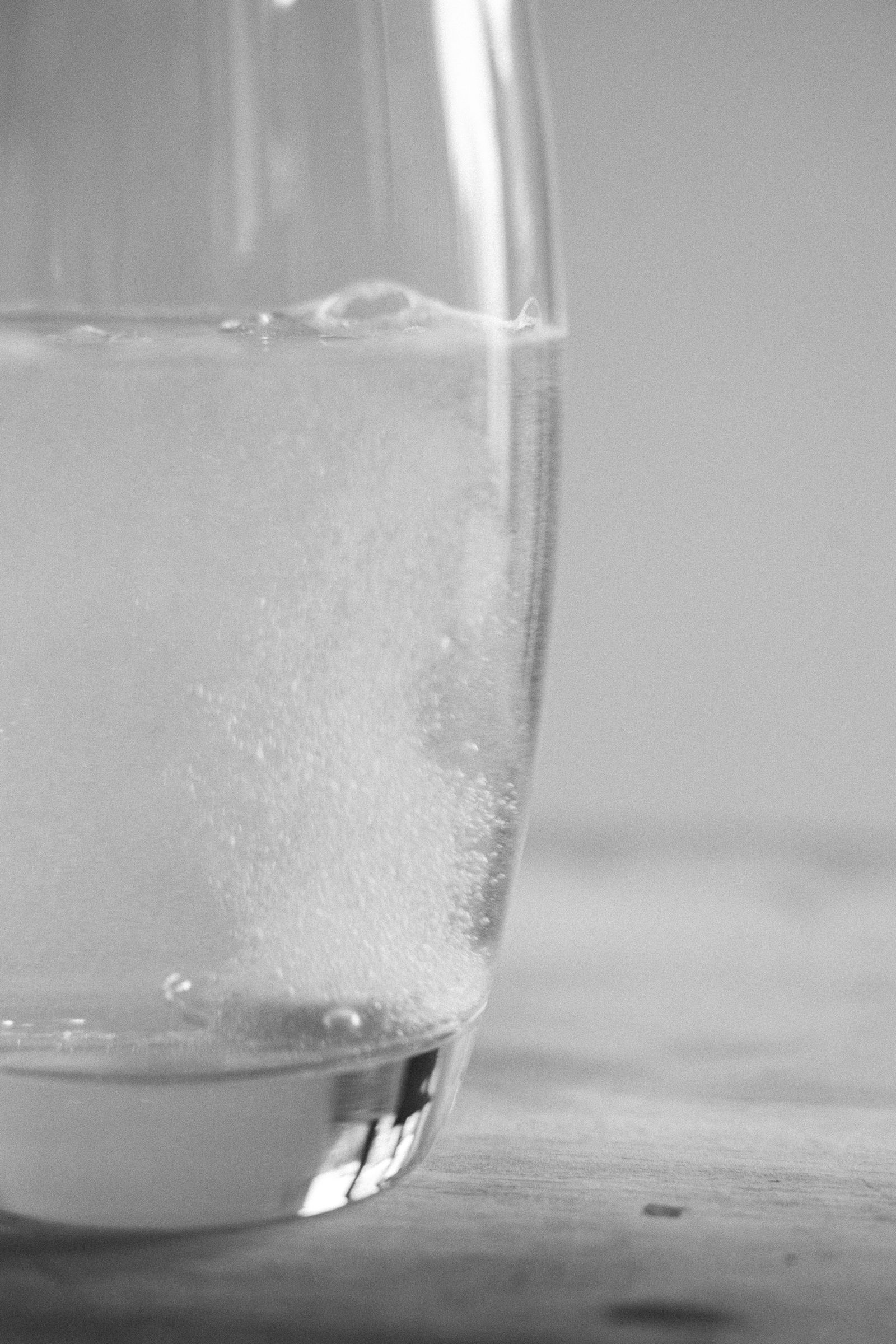
A simple test to tell air from sediment
Most cloudy water on board is caused by dissolved air. When water is pressurised by the pump and then released at the tap, the air comes out as millions of micro-bubbles, which look white. This is common after a refill, after work on the system or when the pump has drawn air. It is harmless.
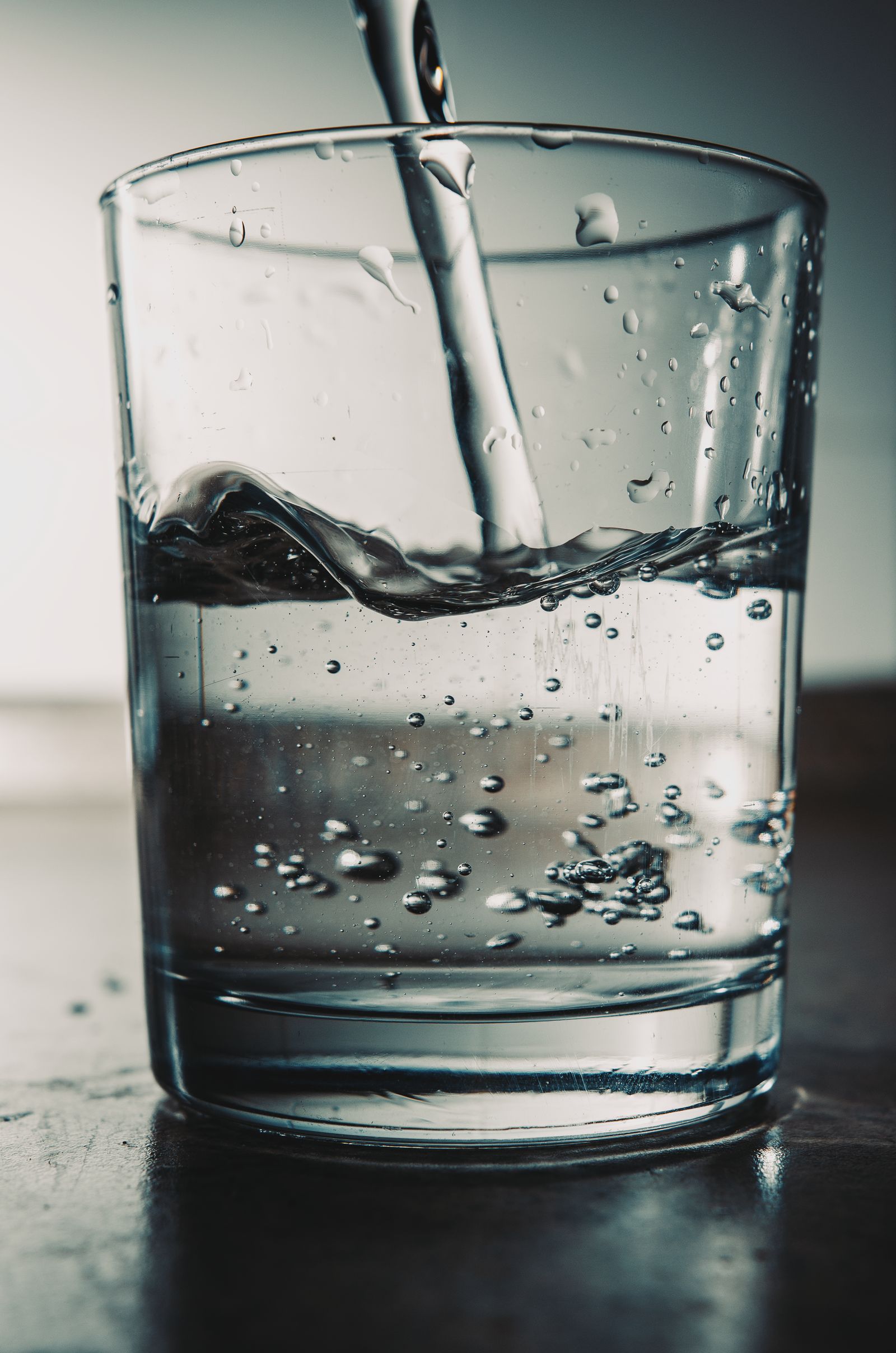
Particles behave differently. They do not rise and escape; they stay suspended or slowly sink. A plain glass of water shows the difference in about two minutes.
- Fill a clean, clear glass with cold water from the affected tap and put it on a flat surface in good light.
- Watch it for one to two minutes without moving it.
- If the water clears from the bottom up and the top clears last, the cloudiness is almost certainly air bubbles rising and escaping.
- If the water stays hazy, or particles settle at the bottom, there is turbidity or sediment in the water.
- If the water has a yellow, brown or reddish tint, note it and repeat with hot water to see if it is worse there.
What can make yacht water cloudy
Once air bubbles are ruled out, the remaining causes are worth investigating properly.
Sediment stirred up in the tank
Refilling at high flow or rough sea can lift sludge from the bottom of the tank and send it into the pipes.
Yacht Fresh-Water Tank CleaningTurbid water from the supply
Water bunkered from an unfamiliar quay or bowser may already carry fine particles or organic matter.
Yacht Water Sampling & AnalysisBiofilm detaching from pipes
Fragments of biofilm — the slimy bacterial layer on pipe walls — can break away after pressure changes or long stagnation.
Yacht Fresh-Water System SanitizationCorrosion in fittings or the calorifier
Rust-coloured water, especially hot, can be associated with corrosion inside the hot water cylinder, pipes or valves.
Yacht Fresh-Water System SanitizationFilters that need changing
Saturated or damaged filters can release particles instead of retaining them, a sign the system needs attention.
Yacht Fresh-Water System Sanitization Biologist
Linda Abenaim, Biologist at Ekonore / AirBio
Cloudy water is not always a bacterial problem. Tiny air bubbles clear from the bottom of the glass within a minute or two; particles or pieces of biofilm do not. That simple check tells us whether to look at the plumbing or at the water quality.
Linda Abenaim · Biologist, Ekonore / AirBio
Fill a clear glass and wait two minutes. If it clears from the bottom up, it is probably air. If it stays cloudy, keep a sample in the fridge and call us.
- Airclears from the bottom up
- Particlesstay suspended or settle
- Biofilmflakes from pipes or tanks
Not sure what your systems actually need?
Tell us the yacht, what the crew has noticed and where she is now: a technician calls you back within 24 hours and plans the survey around your programme.
What to check after the glass test
If the glass test shows more than air, these checks help pinpoint where the cloudiness comes from.
- Repeat the glass test at several outlets, including one close to the tank and one at the far end of the system.
- Compare hot and cold water from the same tap.
- If there are several tanks, switch tanks and repeat the test.
- Check the date and source of the last refill, and whether the cloudiness started afterwards.
- Inspect the accessible pre-filters for discoloration or sediment and check when they were last replaced.
- Keep a sample in a clean, closed bottle to show the technician.
Follow the water from the tank to the tap
Almost every onboard water complaint starts at one of these six points. Knowing which one changes what needs to be done.
- 1
Fresh-water tanks
Sediment settles on the floor and baffles; the surface above the waterline dries and re-wets.
Common source - 2
Pump and accumulator
Water sits in the accumulator between draw-offs, at cabin temperature.
- 3
Filters and UV
A cartridge left in place past its life becomes a surface that holds what it was meant to remove.
Common source - 4
Calorifier
If the stored temperature is too low, the hot side stops being a barrier and becomes a reservoir.
Common source - 5
Distribution lines
Long runs and dead legs to outlets that are rarely opened keep water still for weeks.
Common source - 6
Outlets and showers
The last metre: aerators, hoses and shower heads, where the smell is finally noticed.
Marked in amber: the points where, in our experience on board, the cause is most often found. Treating only the outlet leaves the other five untouched.
How bacteria establish themselves in a water system
Water that stands still at lukewarm temperatures, in pipework where biofilm has had time to form, is the condition that lets bacteria multiply. The video shows the mechanism on a building water system.
On board the same conditions occur in a smaller, more concentrated network: short runs, dead legs, long periods alongside and outlets that are rarely opened.

Cloudy water can be harmless or a warning. Our first job is to tell which, quickly, so the crew knows what to do with the water while we investigate.
Francesco Colombo
CEO · AirBio Marine, a division of AirBio (Ekonore S.r.l.)
Book a water-system surveyWhen cloudy water needs sampling or tank cleaning
If the glass test rules out air, the next step is to find out what is in the water and where it comes from. Microbiological sampling, analysed by an accredited laboratory, and an inspection of the tank show whether the problem is sediment, biofilm, corrosion or the supply itself.
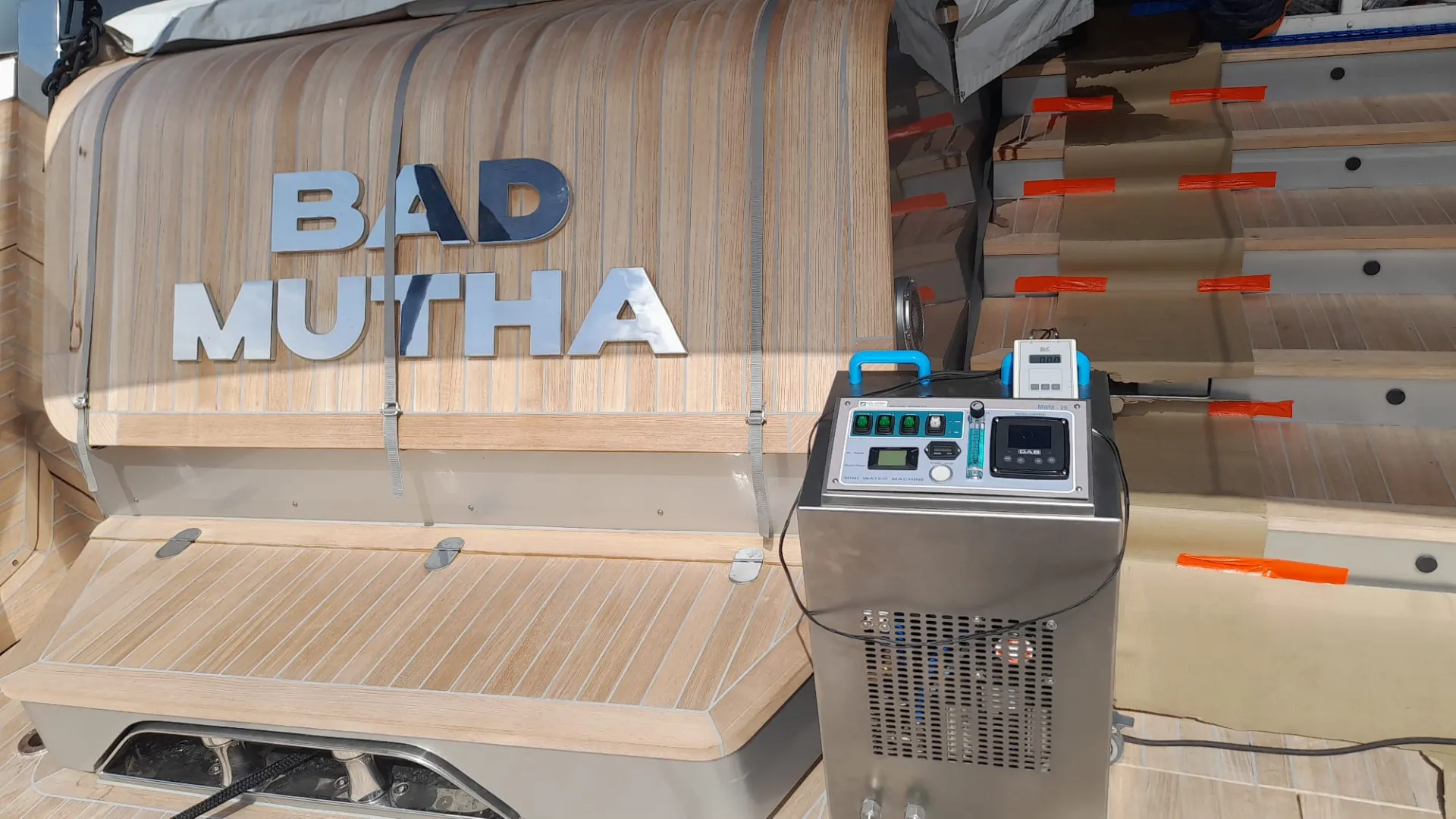
Where sediment or biofilm are found, AirBio Marine can clean and sanitize the tank and distribution system with ozonated water, then document the work in a report with photos.
- The water stays hazy or has particles in the glass test.
- The water is coloured, especially if it is getting worse.
- Cloudiness returns after every refill.
- The yacht has been in lay-up or refit and the tanks have not been cleaned since.
- Guests or crew are concerned and you need documented results.
Questions about cloudy water on yachts
Is milky water from the tap on my yacht dangerous?
If the water clears from the bottom up in a minute or two, the milky look is caused by tiny air bubbles and is harmless. This often happens after refilling or after work on the pump or pipes. If the water stays cloudy, has particles or a colour, the cause is different and the water should be checked before being used for drinking.
Why is the water cloudy right after we refill at the quay?
Two things commonly happen at bunkering: air is drawn into the system, and the incoming flow stirs up sediment in the tank. Air clears quickly in the glass test; sediment does not. If refills regularly produce hazy water, the tank may have a layer of sludge and the incoming water quality is worth checking with sampling.
Why does the hot water look brown but the cold water is clear?
Discoloration only in hot water can be associated with corrosion or deposits in the calorifier or the hot water pipes. Sediment tends to accumulate in the bottom of the hot water cylinder over time. The hot water system should be inspected, and flushing or sanitization may be recommended depending on what is found.
Can a filter solve cloudy water?
A good filter can reduce particles at the point where it is fitted, but it does not remove the cause. If the tank contains sediment or the pipes carry biofilm, filters will clog faster and the problem continues upstream. It is better to find and clean the source, then use filters as a second line of protection.
What does water sampling tell us about cloudy water?
Sampling analysed by an accredited laboratory shows the microbiological quality of the water at the points sampled, and can include other parameters depending on the analysis requested. It turns a visual impression into documented data, which helps the chief engineer decide whether tank cleaning, system sanitization or simply a change of supply is the right response.
Where this comes from
Nothing here is our own invention. These are the public references behind the way we survey, sample and treat a water system. We say plainly which one is law, which is guidance and which is a laboratory method, because they are not the same thing and they do not all apply to every vessel.
WHO — Guide to Ship Sanitation, 3rd edition (2011)
The World Health Organization reference for water, air and food hygiene on board vessels. It is guidance, not law, and it is what most port health authorities work from.
ECDC — Legionnaires’ disease: facts
The European Centre for Disease Prevention and Control on how the bacterium behaves and which man-made water systems it multiplies in.
Directive (EU) 2020/2184 on the quality of water intended for human consumption
EU law setting quality standards for drinking water and introducing risk assessment of domestic distribution systems. It governs the water supplied ashore; whether and how it applies on a private vessel depends on flag and port state rules.
ISO 11731:2017 — Water quality: enumeration of Legionella
The laboratory method used to count Legionella in a water sample. Worth asking which method a laboratory used before comparing two reports.
Verified reviews on Trustpilot
Reviews of La BioDisinfestazione | Ekonore Italia, the group AirBio Marine belongs to.
Services for cloudy or discoloured water

Yacht Fresh-Water Tank Cleaning
Clean, sanitized fresh-water tanks, with every step documented for your crew.

Yacht Water Sampling & Analysis
Objective data on your onboard water, collected properly and explained clearly.

Yacht Fresh-Water System Sanitization
From tank to shower head: the whole fresh-water network, treated as one system.
Tell us about the yacht
Yacht length, marina, systems and what you have noticed on board. A technician reads the message and calls you back to plan the survey.
"*" indicates required fields
Where we work
Italian Riviera and Tuscany marinas and yards — Viareggio, La Spezia, Portofino, Genoa, Sanremo, Livorno, Argentario — and other Mediterranean ports on request.
Documented work
Every job ends with a technical report and photos for the yacht's records.
Not sure where the problem starts?
Let the technical team assess it onboard.
In marina, at the yard or during lay-up. We tell you what needs treating — and what doesn’t.
+39 0584 433 198Expertise.
Peace of mind.