
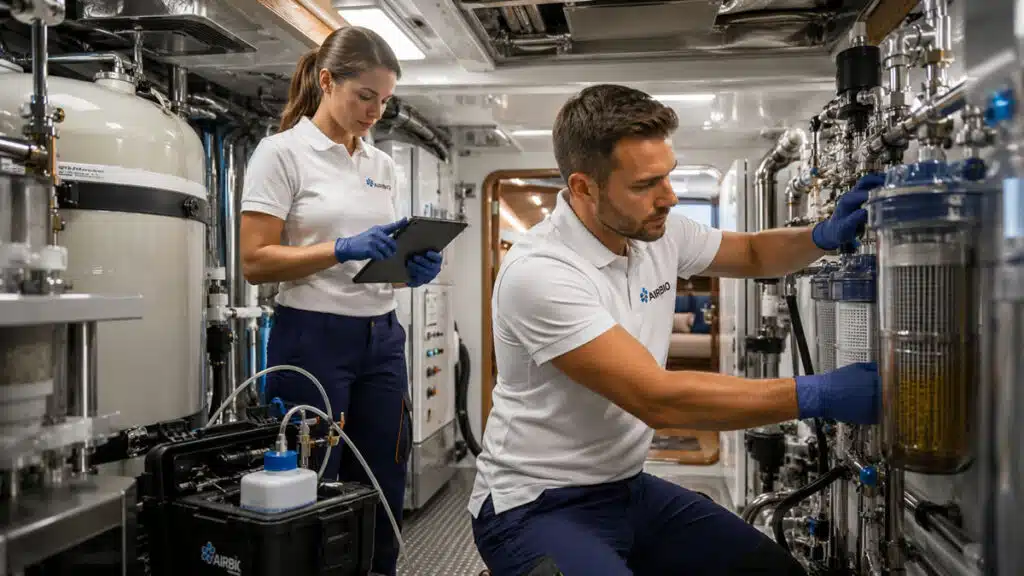
Is My Yacht's Water Tank Contaminated?
Tanks are out of sight, which is exactly why problems grow there.
Every drop of fresh water on board passes through the tank first, yet it is the part of the system the crew sees least. This guide explains the signs that may indicate a contaminated tank, the moments when the risk rises and how sampling helps you decide what to do.
yacht experience
“We’re not sure what’s inside our water tank”
Tank contamination is rarely obvious. It usually shows up indirectly, through the water at the outlets or through the yacht’s recent history.
Water tastes or smells different
A musty, stale or sulphur-like note that appears across the yacht may indicate a problem in the tank rather than in a single line.
Particles or flakes in the water
Dark specks, slimy flakes or fine sediment in a glass or in the filters can come from sludge or biofilm inside the tank.
Filters clog faster than they used to
Pre-filters that need changing more often can be a sign that the tank is releasing more material than before.
Nobody remembers the last tank cleaning
If the tank has not been opened, inspected or sanitized for several seasons, its condition is simply unknown.
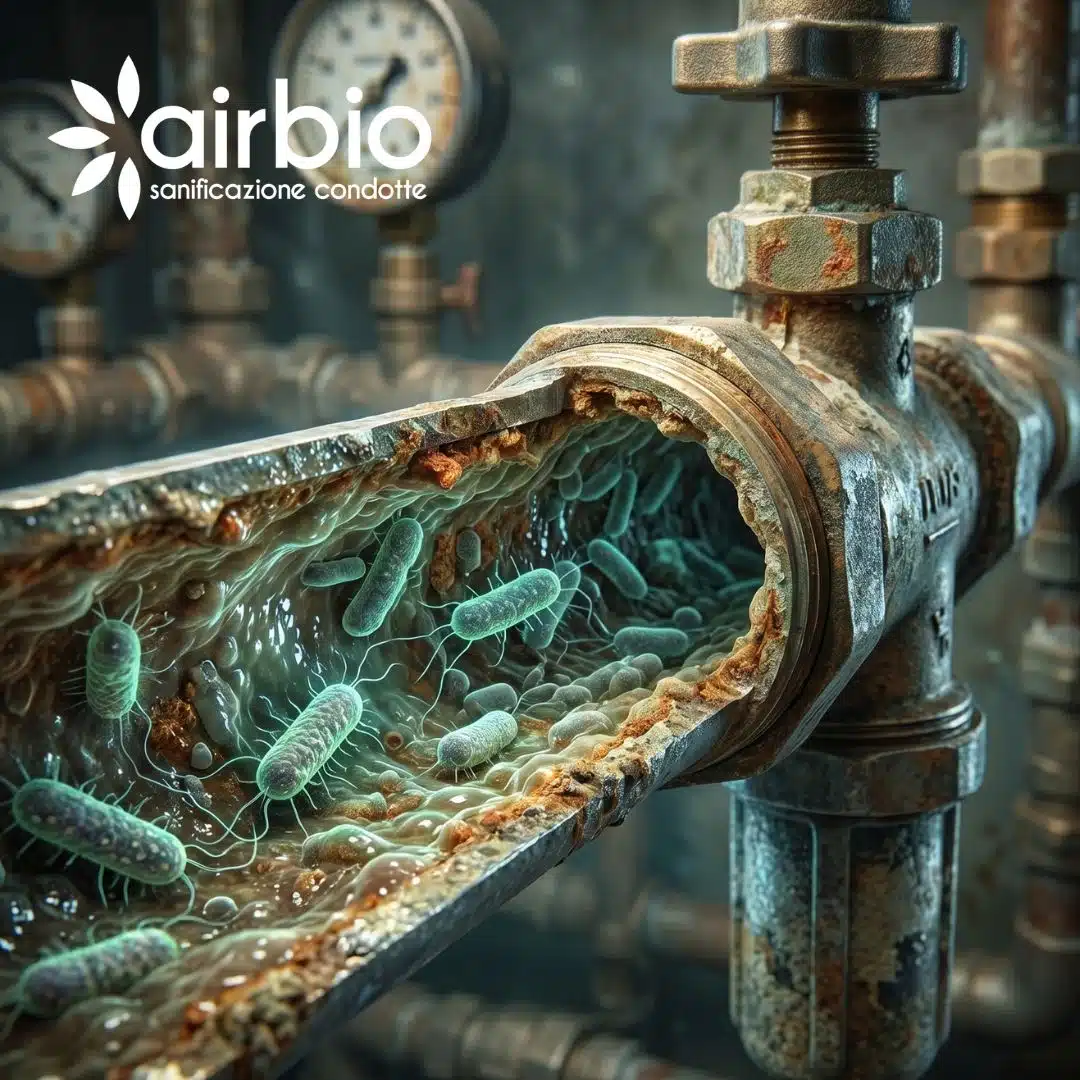
How a fresh-water tank becomes contaminated
A tank is never completely emptied in normal use. A small amount of water and sediment always stays in the bottom, and every refill adds a little more: fine sand, mineral particles and organic matter from the supply. Over time this builds up into a layer of sludge.
The inner walls of the tank and the baffles — the internal plates that stop water sloshing — are ideal surfaces for biofilm, a slimy layer of bacteria that sticks to surfaces and protects them from normal disinfectant levels. Biofilm can shed fragments into the water and makes routine chlorination less effective.
The risk rises at particular moments: after a lay-up with water left standing, after bunkering from an unfamiliar source, and after refit work that opened the tank or the pipework to dust, debris and new materials.
- After lay-up: stagnant water, sometimes warm, for weeks or months.
- After bunkering from unknown sources: water of uncertain quality enters the tank directly.
- After refit: dust, debris and new hoses or coatings may have entered the system.
- After a long charter season: many refills with no break for cleaning.
What can contaminate a yacht water tank
These causes often overlap. Each is linked to the service that addresses it.
Accumulated sediment and sludge
Layers built up over many refills can harbour bacteria and release particles and odours into the water.
Yacht Fresh-Water Tank CleaningBiofilm on walls and baffles
Once established, biofilm is hard to remove by flushing and can keep re-contaminating treated water.
Yacht Fresh-Water Tank CleaningWater of unknown quality at bunkering
Supply from an unfamiliar quay, bowser or hose may carry contamination straight into the tank.
Yacht Water Sampling & AnalysisStagnation during lay-up
Water left in tanks and pipes without use or treatment is a favourable environment for bacterial growth, including Legionella in warm sections.
Legionella Testing for YachtsRefit work and open systems
Opening tanks, replacing pipes or working nearby can let dust and debris into the water system.
Post-Refit Yacht SanitizationNot sure what your systems actually need?
Tell us the yacht, what the crew has noticed and where she is now: a technician calls you back within 24 hours and plans the survey around your programme.
What the crew can check without opening the tank
These checks give a first picture and useful information for the technician.

- Look in the engineering log for the date of the last tank inspection, cleaning and sanitization.
- Note the dates and sources of the last few refills, including any water from a bowser or unfamiliar quay.
- Inspect the pre-filters after the tank: colour, slime or sediment are useful clues.
- Do a glass test at an outlet near the tank and look for particles or flakes after the water settles.
- If there are several tanks, compare the water from each one for smell and clarity.
- Check whether the tank vent and filling cap are intact and properly closed.
Follow the water from the tank to the tap
Almost every onboard water complaint starts at one of these six points. Knowing which one changes what needs to be done.
- 1
Fresh-water tanks
Sediment settles on the floor and baffles; the surface above the waterline dries and re-wets.
Common source - 2
Pump and accumulator
Water sits in the accumulator between draw-offs, at cabin temperature.
- 3
Filters and UV
A cartridge left in place past its life becomes a surface that holds what it was meant to remove.
Common source - 4
Calorifier
If the stored temperature is too low, the hot side stops being a barrier and becomes a reservoir.
Common source - 5
Distribution lines
Long runs and dead legs to outlets that are rarely opened keep water still for weeks.
Common source - 6
Outlets and showers
The last metre: aerators, hoses and shower heads, where the smell is finally noticed.
Marked in amber: the points where, in our experience on board, the cause is most often found. Treating only the outlet leaves the other five untouched.
How bacteria establish themselves in a water system
Water that stands still at lukewarm temperatures, in pipework where biofilm has had time to form, is the condition that lets bacteria multiply. The video shows the mechanism on a building water system.
On board the same conditions occur in a smaller, more concentrated network: short runs, dead legs, long periods alongside and outlets that are rarely opened.
When to test the water and when to clean the tank
Water sampling and tank sanitization answer different questions. Sampling, with analysis by an accredited laboratory, shows the microbiological quality of the water at a given moment. Sanitization deals with what is inside the tank: sediment and biofilm are removed and the tank is treated with ozonated water, with residual readings and a report at the end.
Where the hot water system has been stagnant or warm, Legionella testing can be added. A negative result is a snapshot of that day, not a guarantee for the future, so it works best as part of a regular plan.
- The tank has not been inspected or sanitized for more than a season.
- The yacht is coming out of lay-up or refit.
- You have bunkered water from a source you do not know.
- Taste, smell, particles or clogged filters appear across the yacht.
- The management company or charter programme expects documented water quality.
Inside a fresh-water tank, before and after sanitization
Illustrative images, not photos of a specific job: they show typical sediment and biofilm in a tank and the same tank after cleaning and sanitization.


Illustrative visual showing the type of condition we find and the result we work towards. Photos of real AirBio Marine jobs are shown in the gallery below and in every client report.
Questions about contaminated water tanks
How can I tell if my yacht water tank is contaminated?
You often cannot tell by looking at the water. Signs such as a stale or sulphur smell, particles, slimy flakes in filters or filters clogging faster may indicate a problem, but clear water is not proof of good quality. Microbiological sampling analysed by an accredited laboratory, together with an inspection of the tank, is the reliable way to know.
Is chlorinating the tank enough?
Chlorination helps keep water in good condition, but it has limited effect on sediment and established biofilm, which protect bacteria from normal disinfectant levels. If the tank already contains sludge or biofilm, it should be cleaned and sanitized first. Adding more chlorine to compensate can also damage seals and coatings and cause taste problems.
Should the tank be checked after winter lay-up?
Yes, it is a sensible moment. Water that has stood for weeks or months, sometimes in warm conditions, gives bacteria time to multiply and biofilm to develop. Before owners or guests return, draining, inspecting and sanitizing the tank as needed, followed by sampling, gives the crew a documented starting point for the season.
What is the difference between water sampling and tank sanitization?
Sampling measures: it tells you what is in the water at the points and time sampled. Sanitization acts: it removes sediment and biofilm and treats the tank and, if needed, the distribution system. Sampling is often done before, to decide whether treatment is needed, and after, to check the outcome, but one does not replace the other.
Can a contaminated tank lead to Legionella in the system?
The tank itself is usually cold, but sediment and biofilm from it can travel into warmer parts of the system, such as the calorifier and hot lines, where Legionella can grow in the right conditions. If the system has been stagnant or the hot water runs lukewarm, Legionella testing is worth adding. No single test guarantees future results, so regular checks matter.
Verified reviews on Trustpilot
Services for water tanks and water quality

Yacht Fresh-Water Tank Cleaning
Clean, sanitized fresh-water tanks, with every step documented for your crew.

Yacht Water Sampling & Analysis
Objective data on your onboard water, collected properly and explained clearly.

Legionella Testing for Yachts
A structured sampling plan, accredited lab analysis and results explained clearly.

Yacht Fresh-Water System Sanitization
From tank to shower head: the whole fresh-water network, treated as one system.
Book the survey before your next movement
We work in the main Mediterranean marinas and refit yards, with documented results and lab analysis where required.
Tell us about the yacht
Yacht length, marina, systems and what you have noticed on board. A technician reads the message and calls you back to plan the survey.
"*" indicates required fields
Where we work
Italian Riviera and Tuscany marinas and yards — Viareggio, La Spezia, Portofino, Genoa, Sanremo, Livorno, Argentario — and other Mediterranean ports on request.
Documented work
Every job ends with a technical report and photos for the yacht's records.
Not sure where the problem starts?
Let the technical team assess it onboard.
In marina, at the yard or during lay-up. We tell you what needs treating — and what doesn’t.
+39 0584 433 198Expertise.
Peace of mind.