
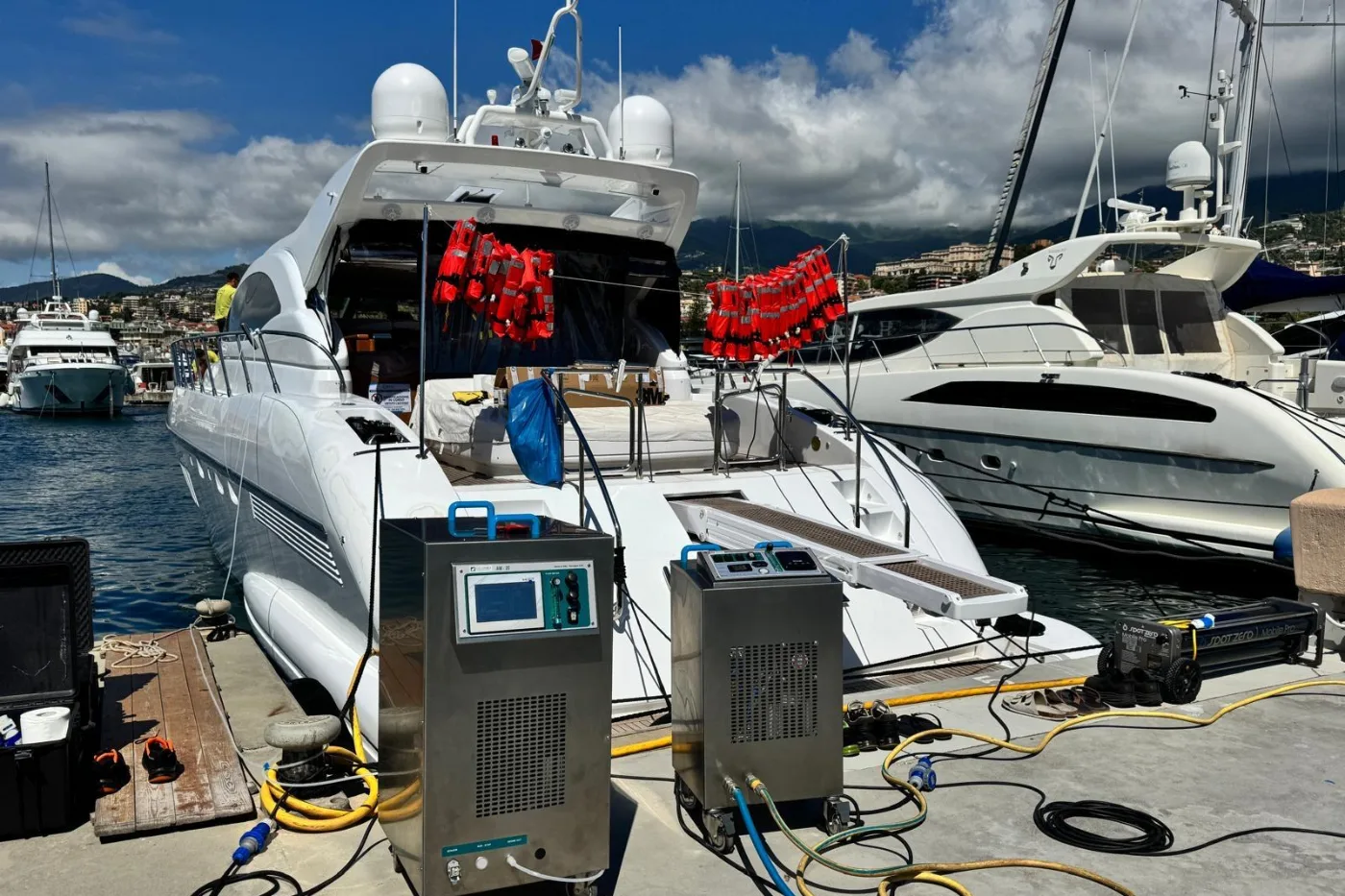
How a Sanitization Job Runs on Board
Five stages: survey, plan, clean, sanitize, verify — and a written report at the end.
Most jobs are done alongside, with the yacht in her berth and no yard move. We agree the hours with the crew, work around the programme and leave the spaces usable. What follows is the same sequence on every job, whether it is one cabin fan coil or a full water system.
What happens, in order
Each stage has to be finished before the next one starts. Skipping the cleaning stage is the single most common reason a smell comes back a few weeks later.
Inspect
A technician comes on board and looks at the actual system: filters, coils, condensate trays, duct runs, galley canopy, tanks, calorifier and the taps furthest from the pump. Temperatures are measured, and water samples are taken when the case calls for it. Nothing is quoted before this.
Plan
You get a written plan: which units and which lines are treated, how many hours, which spaces are out of use and when, and what the crew needs to prepare. If the yacht is chartering or in a turnaround, the plan is built around the window you have.
Clean
The mechanical part, and the part most often skipped. Filters out, coils and fins cleaned, condensate trays and drain lines cleared, ducts opened and cleaned, galley canopy and baffle filters degreased. A surface cannot be sanitized while it is still covered in dust or grease.
Sanitize
Only once the system is clean. The protocol is chosen for the system in front of us — air side or water side, and the material it is made of. On the water side this is a controlled disinfection of tanks, calorifier and the whole distribution line, followed by flushing until the residual is back to normal.
Verify and document
Final checks, and laboratory analysis when the job involves drinking water or a Legionella question. You receive photographs before and after, the products used, and the analysis results when they apply. That report is what a surveyor, an insurer or the next captain can read.
Almost nothing, and that is the point
On a normal job the crew does very little. We bring our own technicians, equipment and service van; the units and hoses stay on the quay or in the passerelle area, and only the working space inside is occupied.
What helps is knowing in advance which cabins can be closed, where the tank hatches and the calorifier are, and who holds the keys to the technical spaces. If the yacht is on shore power and the water system is in use, we plan the water side so there is a period without fresh water rather than a surprise.
Guests and crew do not need to be off the yacht for most air-side work. For a full water-system disinfection the system is out of use for a few hours, so that is usually planned at a changeover or during a pre-season stop.
What you are left holding
What is in the report
The list of units, lines or spaces treated, the products used with their data sheets, photographs before and after each stage, and the date and hours worked. If samples were taken, the laboratory report is attached as it came from the lab.
When laboratory analysis is included
Whenever the job touches drinking water, or when a Legionella problem is being treated. Water samples are analysed by an external laboratory; we do not produce the numbers ourselves.
Who does the work
AirBio technicians, employed and trained in-house. We do not subcontract the crew that comes on board, which is why the same people can come back next season and know the yacht.
What we do not claim
We do not certify a yacht as compliant with anything. A private yacht is not covered by the public drinking-water rules, and no cleaning makes a system permanently sterile. What the report says is what was done and what was measured.
Where this comes from
These are the public references behind the way we survey, clean and check a system on board. Two are health guidance, one is the trade standard for air systems, one is the laboratory method for counting Legionella. None of them is a legal requirement for a private yacht.
WHO — Guide to Ship Sanitation, 3rd edition
Health guidance for vessels: how drinking water, air conditioning and food areas should be managed on board. It is guidance, not law.
ACR, the NADCA Standard for Assessment, Cleaning and Restoration of HVAC Systems
The reference most widely used for how an air handling system should be assessed, cleaned and checked. It is a trade standard, not a legal requirement.
ECDC — Legionnaires’ disease facts
How the bacterium spreads, who is most at risk and why warm stagnant water matters. Information, not a compliance rule.
ISO 11731:2017 — Enumeration of Legionella
The laboratory method used to count Legionella in a water sample. It defines how a sample is analysed, not when you must sample.
The method: questions we are asked
How long does a job take?
A single fan coil or one split unit is a matter of hours. A full air system on a 30 to 40 metre yacht is normally one to three days. A complete water-system disinfection is usually one day, with the system out of use for part of it. The survey gives you the hours before you commit.
Do we have to move the yacht to a yard?
No. Almost everything is done alongside, in the berth, with our equipment on the quay. A yard move is only relevant when the work is part of a wider refit that is happening there anyway.
Can the yacht be used while you work?
Air-side work is done space by space, so the rest of the yacht stays in use. Water-side disinfection needs the fresh-water system offline for a few hours, which is why it is usually planned at a changeover or during a lay-up.
Do you sanitize without cleaning first, if we are short of time?
No. A disinfectant applied over dust or grease does not reach the surface underneath, and the smell comes back. If time is short we reduce the number of units treated rather than skip the cleaning stage.
Will this make the system sterile?
No, and nothing does. A yacht system takes in air, water and people continuously. What a job does is bring the system back to a clean starting point and remove what was feeding the problem; how long that lasts depends on use and on routine maintenance.
Start with the survey
Tell us the yacht, the berth and what the crew has noticed. A technician calls you back within 24 hours and comes to look before anything is quoted.
Tell us about the yacht
Yacht length, marina, systems and what you have noticed on board. A technician reads the message and calls you back to plan the survey.
"*" indicates required fields
Where we work
Italian Riviera and Tuscany marinas and yards — Viareggio, La Spezia, Portofino, Genoa, Sanremo, Livorno, Argentario — and other Mediterranean ports on request.
Documented work
Every job ends with a technical report and photos for the yacht's records.