
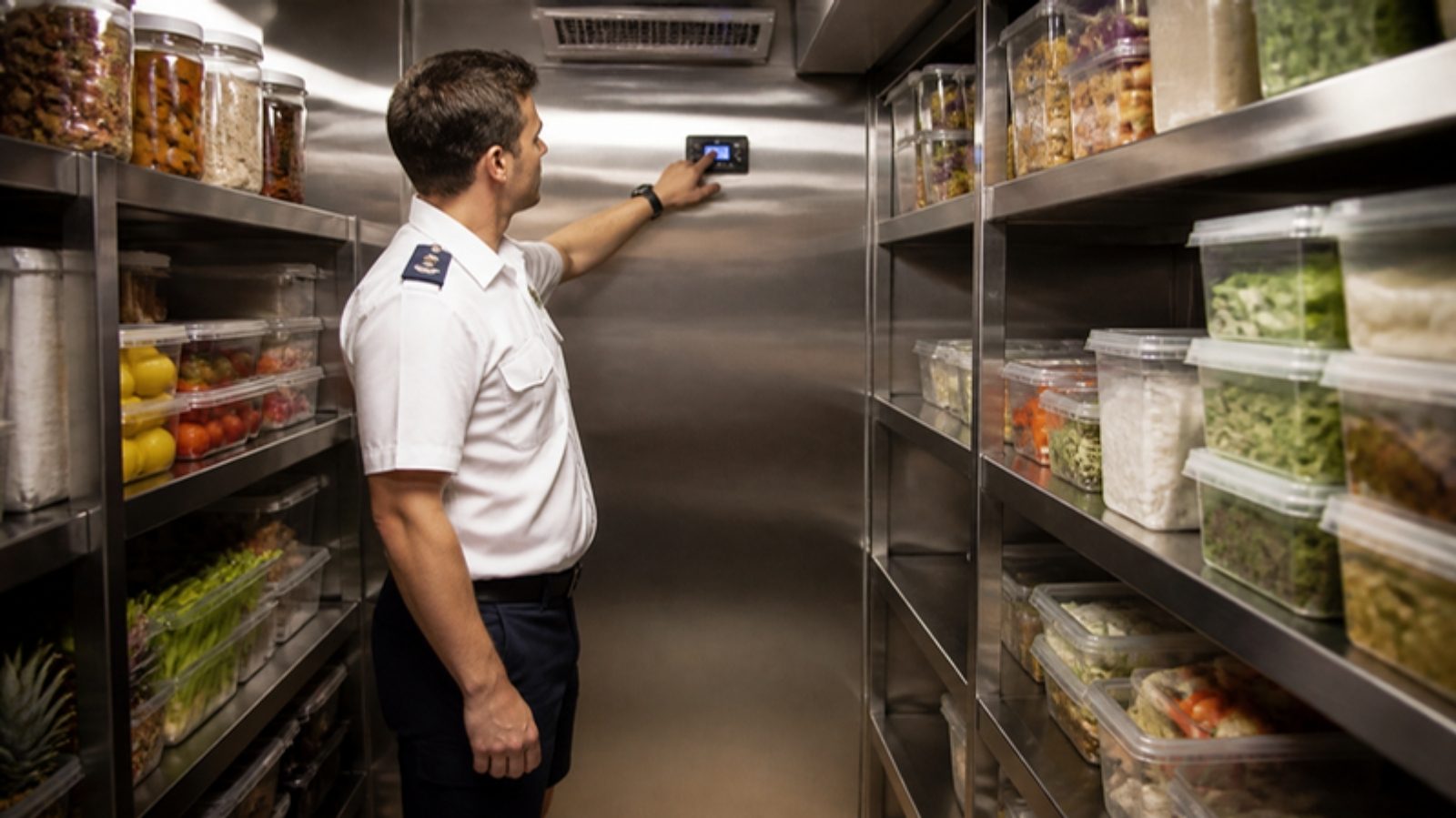
Fridges, cold rooms and the provisions store: keeping them clean and cold
What the WHO ship guide says about storing food on board, checking temperatures and keeping raw and ready-to-eat food apart.
Yachts carry food for weeks. If the fridge is too warm, or raw food sits above cooked food, the risk is real. This guide explains what the WHO Guide to Ship Sanitation says and what a simple routine looks like.
Why storage matters on a yacht
Food on a yacht is bought in bulk, often in a foreign port, and kept for a long time. Storage is where small mistakes add up: a door that does not seal, a fridge that is overfull, a spill nobody wiped.
This page covers cleaning and temperature checks in plain words. We do not give temperature limits here. The WHO guide points to other documents for those, and your flag, charter rules or food safety plan may set them. Use the limits in your own plan.
What the WHO guide says
The WHO Guide to Ship Sanitation says that improper storage of provisions is a hazard on seagoing ships, because provisions are often carried for many weeks or months.
It says the ship's operators must have systems to make sure temperature is controlled effectively, and that the measuring devices must be checked at regular intervals and tested for accuracy. It also says raw food, especially meat, needs to be kept apart from ready-to-eat food, by space or by time, with good cleaning in between. For example temperatures, the guide points to Vessel Sanitation Program documents and the Codex Alimentarius.
The key points from the WHO guide
From the food chapter of the Guide to Ship Sanitation.
Want the fridges and stores checked?
Tell us how the yacht is used. We will suggest a routine.
The points to remember
Temperature. Know the limit in your plan, read the thermometer at set times, and write it down. The guide says the devices themselves must be tested for accuracy, so a fridge display alone is not proof.
Separation. Raw meat and fish go on the lowest shelf, below ready-to-eat food, so nothing drips down. This is our practical advice, in line with the guide rule to keep raw and ready-to-eat food apart.
Cleaning. Wipe shelves, door seals and drains on a schedule, and after any spill. A film or smell inside a fridge means something is being missed.
Fridges and cold rooms
- Read and record the temperature of every fridge and cold room at set times.
- Check the door seals close tightly, and that drains and drip trays are clear.
- Do not overfill: air needs to move around the food.
- Label and date opened food. Throw out anything past its date.
- Clean and dry after every spill.

Most food problems start with something small that nobody wrote down. A simple log beats a good memory.
Francesco Colombo
CEO · AirBio Marine, a division of AirBio (Ekonore S.r.l.)
Book a galley and stores cleanVerified reviews on Trustpilot
The dry and provisions store
Store dry goods off the floor, away from walls and pipes, where you can see and clean underneath. Check boxes and packaging for damage when they come on board, and open them outside the food area if you can.
Pests follow food. See pests, food stores and how to keep them out.
How we check and clean food storage areas, step by step
Five steps, planned with the chef and the captain.
Look with the chef
We walk through fridges, cold rooms and stores.
Check the basics
Seals, drains, shelves, spills and signs of pests.
Clean and sanitize
We clean, then sanitize surfaces with products suited to food areas.
Note what needs repair
We list door seals, drains and thermometers that need fixing.
Report
You get photos and a short list of actions.
Clean first, then sanitize. A sanitizer on a dirty shelf does very little.
Francesco Colombo
CEO · AirBio Marine, a division of AirBio (Ekonore S.r.l.)
Speak to our teamA simple routine
Watch for a sour or musty smell in a fridge, water pooling on the floor of a cold room, ice building up around a door, food that spoils faster than usual, and any sign of droppings or gnawed packaging.
Warning signs
Keep the temperature log, the cleaning list and the pest checks together in the ship file. A written record is what an inspector or a charter manager will ask to see first.
Questions
What temperature should a yacht fridge be?
We do not give a number here. The WHO guide points to Vessel Sanitation Program documents and the Codex Alimentarius. Use the limit in your own food safety plan.
Do thermometers need checking?
Yes. The WHO guide says temperature devices must be checked at regular intervals and tested for accuracy.
Where does raw meat go?
Apart from ready-to-eat food. The WHO guide says to separate them by space or by time; the lowest shelf is a common way to do it.
How long can food be kept?
It depends on the food and the label. The WHO guide notes that provisions are carried for weeks or months, so storage must be well controlled.
How often should we clean?
After any spill, and on a set schedule that suits how the yacht is used. Write the schedule down.
Can AirBio Marine clean the stores?
Yes. We clean and sanitize galleys, fridges and stores and give you a photo report.
References
- World Health Organization — Guide to Ship Sanitation, 3rd edition (2011), chapter 3: Food.
Want the galley and stores checked?
We inspect, clean and sanitize, and show you the photos.
Speak to a marine technicianRelated on AirBio Marine
Ready to clean the galley and stores?
Inspection, cleaning and a photo report, at the berth.
Verified reviews on Trustpilot
Tell us about the yacht
Yacht length, marina, systems and what you have noticed on board. A technician reads the message and calls you back to plan the survey.
"*" indicates required fields
Where we work
Italian Riviera and Tuscany marinas and yards — Viareggio, La Spezia, Portofino, Genoa, Sanremo, Livorno, Argentario — and other Mediterranean ports on request.
Documented work
Every job ends with a technical report and photos for the yacht's records.