
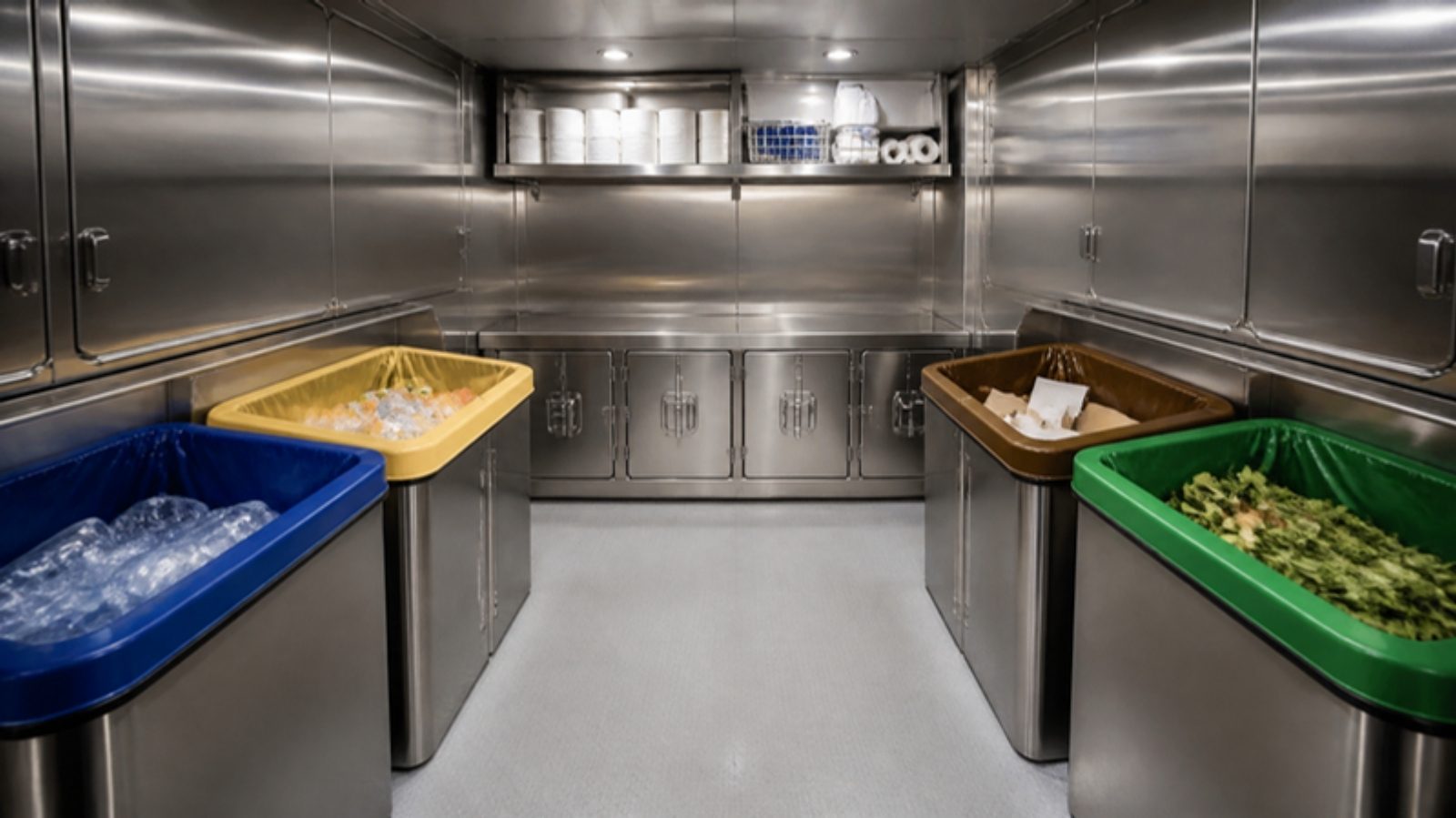
Yacht Garbage Room Hygiene: What MARPOL Annex V Says
What the IMO says about ship garbage, and the simple habits that keep a garbage room from becoming a smell, pest and hygiene problem.
Garbage rules at sea come from MARPOL Annex V. This guide explains what the IMO says, in plain words, and adds practical hygiene points. We say clearly what we could not confirm.
Why the garbage room matters
Every yacht makes waste: food scraps, packaging, used cooking oil, cleaning products and more. It has to be kept somewhere on board until it can be landed or, where the rules allow, disposed of at sea.
That store room is often small, warm and out of sight. This is why it is one of the first places where smells, flies and pests appear.
What MARPOL Annex V covers
MARPOL Annex V is the part of the international MARPOL convention that deals with garbage from ships. According to the IMO, it covers "all kinds of food, domestic and operational waste, all plastics, cargo residues, incinerator ashes, cooking oil, fishing gear, and animal carcasses".
The IMO says the Annex entered into force on 31 December 1988 and that it generally prohibits discharging garbage into the sea, except as provided in specific regulations.
The key points from the IMO
From the IMO page on prevention of pollution by garbage from ships.
Book an onboard survey
Photos and a clear list of what needs attention.
The points to remember
Scope. Annex V covers garbage, including cooking oil. It is not the same as the rules on sewage or on dirty water from sinks and showers.
Placards. The IMO says ships of 12 metres or more must display placards telling passengers and crew the disposal rules, in the crew working language and in English, French or Spanish.
Record book. The IMO says ships of 100 gross tonnage and above, and ships certified to carry 15 or more people, must keep a Garbage Record Book. Entries note date, time, position and what was disposed of. Records are kept for two years.
What we could not confirm. We did not find a source for the exact rules that apply to a given yacht, which depend on size, flag and area. Ask your flag state or class society.
Where hygiene problems start
Most problems start with the same few things: food scraps that stay too long, bins without lids, and floor drains that are never cleaned.
Used cooking oil is on the IMO list of garbage, so it should not be poured down a drain. Grease also builds up in galley filters and ducts: see how often to clean galley hood filters.
Pests are drawn to food waste. Our guide to pests in food stores explains what to look for.

Most smells on a yacht have a boring cause: something stayed where it should not. A good routine beats a strong product.
Francesco Colombo
CEO · AirBio Marine, a division of AirBio (Ekonore S.r.l.)
Book a garbage room and galley checkVerified reviews on Trustpilot
Records and placards
Annex V is mostly about what may be discharged and what must be recorded. It is not a cleaning standard.
For hygiene, a good general reference is the WHO Guide to Ship Sanitation, which is written for regulators, ship operators and builders. We did not find a page that sets cleaning steps for yacht garbage rooms, so the routine below is our own field practice.
Our method
How we look at the garbage room and the galley around it, step by step
Look and smell
We check the room, bins, lids and floor for residue and odour.
Check the drains
We look at the drain and the area around it for slime and standing water.
Check the galley next door
Filters, hood and ducts carry grease that feeds the same problem.
Clean what can be cleaned
Surfaces and equipment, with products suited to the material.
Report
Photos and a short list of what to change in the routine.
Ask the crew where the waste goes after dinner. The answer tells you where to look.
Francesco Colombo
CEO · AirBio Marine, a division of AirBio (Ekonore S.r.l.)
Speak to our teamA simple routine
This is an example, not a rule. Adjust it to your yacht and your crew.
Daily. Empty food waste, close lids, wipe the floor and bin rims, check the drain is clear.
Weekly. Wash bins, clean the floor and drain, check for pests and for leaks.
Before a charter or a season. Check the galley filters, the hood and the ducts too. See our yearly hygiene calendar.
Warning signs
Call for help if you see one of these:
- A smell that returns a few hours after cleaning.
- Flies or small insects around the drain.
- Grease on walls or ceiling near the galley.
- Droppings, gnaw marks or torn packaging.
- Water standing on the floor.
Questions
What is MARPOL Annex V?
It is the part of the international MARPOL convention that deals with pollution by garbage from ships. The IMO says it covers food, domestic and operational waste, plastics, cooking oil and more.
Does it apply to my yacht?
It depends on size, flag and area. The IMO says placards are needed on ships of 12 metres or more, and a Garbage Record Book on ships of 100 gross tonnage or more or certified for 15 or more people. Check with your flag state.
Can I pour used cooking oil down the drain?
The IMO lists cooking oil as garbage under Annex V, so it should be stored and landed or handled as your rules require. Do not pour it down a drain.
Is Annex V a cleaning standard?
No. It deals with what may be discharged and what must be recorded. For hygiene, see the WHO Guide to Ship Sanitation and your own routine.
How often should the garbage room be cleaned?
We did not find an official interval. We suggest emptying food waste every day and a full wash every week, adjusted to your use.
Do you clean garbage rooms?
Tell us about it when you request a survey. We check the room together with the galley, ducts and air system, and tell you what we recommend.
References
- IMO — Prevention of pollution by garbage from ships. International shipping rules.
- WHO — Guide to Ship Sanitation, 3rd edition (2011). A general reference for ships.
Talk to us before the season
Tell us the yacht, the port and what worries you. We reply with a plan.
Request a surveyRelated on AirBio Marine
Want a second pair of eyes on board?
We inspect, clean where needed and send a photo report.
Verified reviews on Trustpilot
Tell us about the yacht
Yacht length, marina, systems and what you have noticed on board. A technician reads the message and calls you back to plan the survey.
"*" indicates required fields
Where we work
Italian Riviera and Tuscany marinas and yards — Viareggio, La Spezia, Portofino, Genoa, Sanremo, Livorno, Argentario — and other Mediterranean ports on request.
Documented work
Every job ends with a technical report and photos for the yacht's records.