
What Is a Water Safety Plan for a Yacht?
A water safety plan is a written way of managing drinking water from the pier to the tap. Here is what the WHO guide for ships says it contains and how to use it on a yacht.
A water safety plan is a written, step-by-step approach to keeping drinking water safe, from the source to the tap. The WHO Guide to Ship Sanitation says a plan should be designed and put in place for the ship’s water system, and that it has three parts: assessing the system, monitoring the control points, and managing and recording the results.
Why a plan and not just a test
A water test tells you how the water was on the day the sample was taken. A plan tells you how to keep it safe every day, and what to do when something changes.
On a yacht, water passes through several hands before it reaches a cabin: the port supply, the hose, the tank, the pumps, the heaters and the taps. Each step can add a risk, so the plan follows the water along that whole path.
What the WHO guide says
The clearest written source is chapter 2 of the WHO Guide to Ship Sanitation (3rd edition, 2011). It is a guideline, not a law, and it is written for ships in general, so a yacht’s own flag and class rules come first.
- A water safety plan is the overall management approach for keeping a drinking-water supply safe.
- It has three parts: a system assessment (describing the water path, finding hazards, judging risks and choosing control measures), operational monitoring of those control measures, and management and communication (checks, procedures and supporting programmes).
- Whoever is responsible for each link in the chain prepares a plan for their own part. The guide names the water supplier, the port and its water supplier, and the ship owner or operator.
- The guide’s guideline 2.3 says a plan should be designed and implemented for the ship’s water system.
- An annex gives examples of hazards, control measures, monitoring and corrective actions for a ship’s water system.
The chapter does not say how often the plan should be reviewed, so we do not give a figure. Set it with the yacht’s management or class.
Four figures from the WHO guide
From the WHO Guide to Ship Sanitation, chapter 2 (potable water).
Do you have a written water plan on board?
Tell us about the vessel. We will suggest what to write down and check first.
The key figures
A plan is easier to keep than it sounds. It is mostly a short set of questions, answered in writing and updated when something changes.
If something goes wrong, the guide lists the kind of corrective actions to plan for: repairing filters, pipes or tanks, removing cross-connections, cleaning transfer equipment, using alternative sources and retraining crew.
What a plan looks at on a yacht
Source. Where the water comes from, and whether the port supplier has its own plan.
Filling. Hoses, connectors and the filling point. The WHO guide asks for a chlorination unit on water entering the tanks.
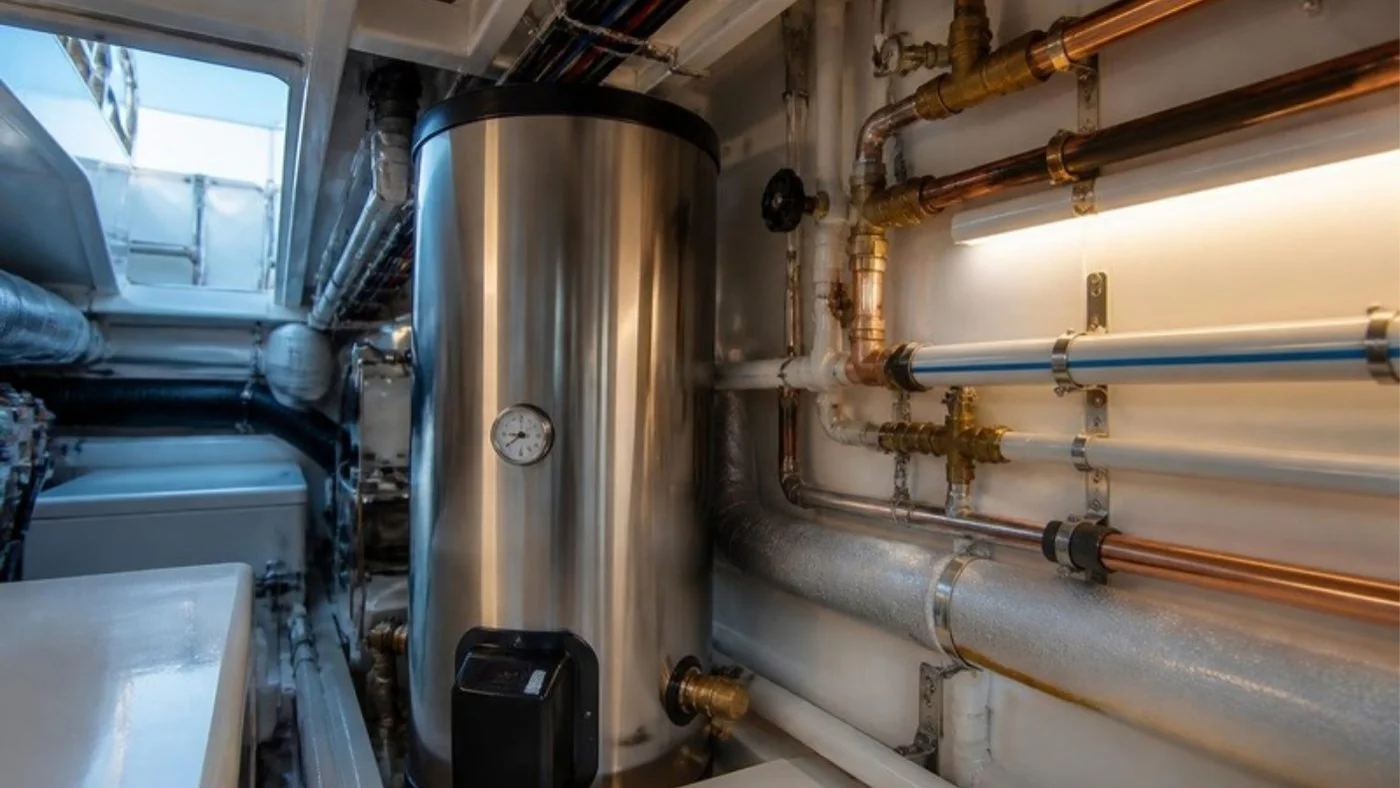
Tanks. Inspected, cleaned and disinfected at every dry or wet dock, or every two years, whichever comes first. See our tank inspection guide.
Hot water. Water should leave the calorifier at least 60°C and return not colder than 50°C. Cold water should be stored below 25°C.
Outlets. Showerheads cleaned and disinfected every six months.

A test is a photograph. A plan is the habit that keeps the picture good. We help crews write down what they already do, and fix what they do not.
Francesco Colombo
CEO · AirBio Marine, a division of AirBio (Ekonore S.r.l.)
Book a water-system surveyVerified reviews on Trustpilot
What we do on board
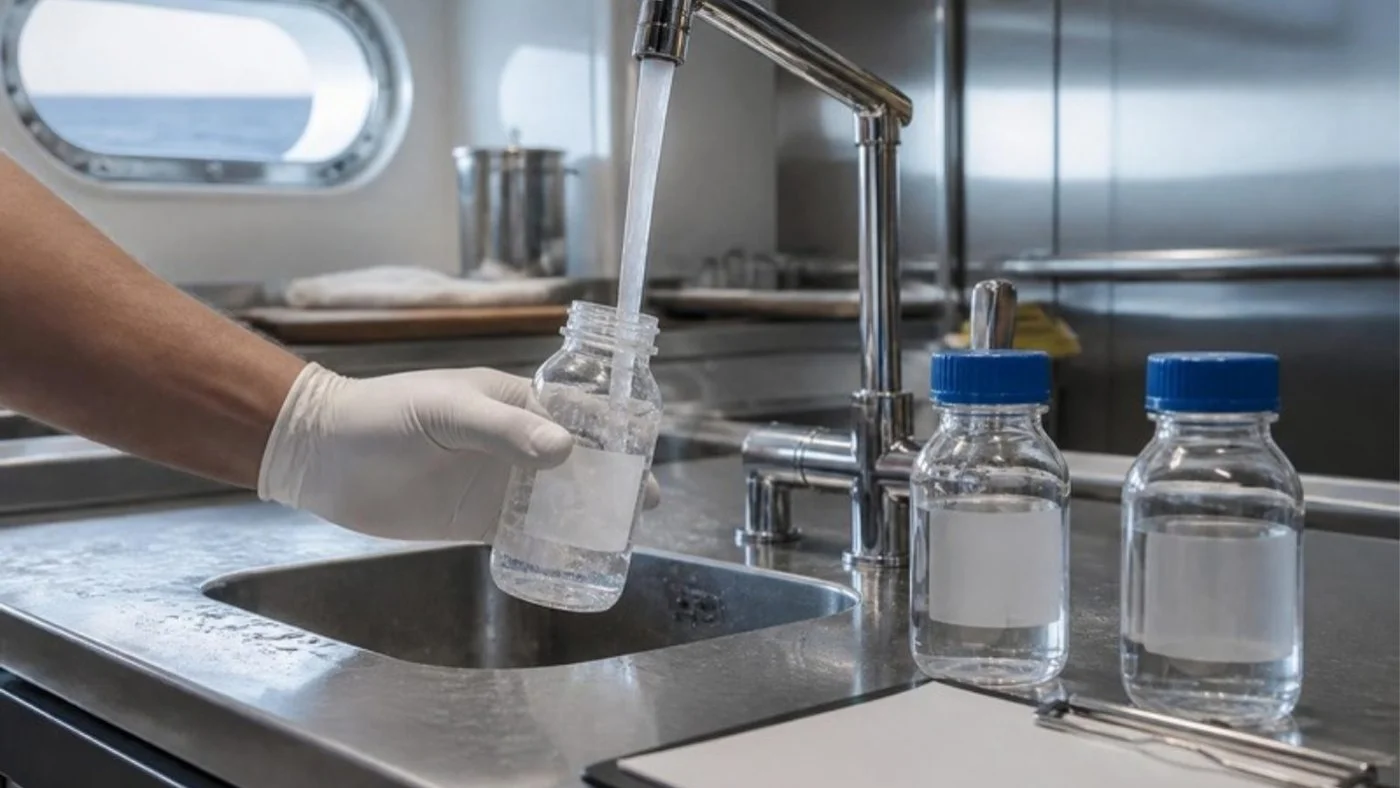
We help turn the plan into a routine: a survey of the system, sanitization where it is needed, and water samples sent to a laboratory. Everything is written into a report for the yacht’s file.
See our water system sanitization and water sampling services.
How we build a water routine with the crew
Five steps, done at the berth.
Survey
We follow the water from filling point to the last outlet and note risks.
Set control points
Agree what is checked, by whom and how often.
Clean and sanitize
Tanks, calorifiers and outlets are treated where needed.
Sample
Sterile samples go to a laboratory and results are read with the crew.
Record
Every step and result goes into the yacht’s water file.
The best plans are short and used. We prefer one page the crew reads over twenty pages nobody opens.
Francesco Colombo
CEO · AirBio Marine, a division of AirBio (Ekonore S.r.l.)
Speak to our teamA sample routine
A starting point built on the WHO guide. Adjust it to the vessel.
- Every fill: use a clean hose, check the chlorine level of incoming water.
- Every dry or wet dock, or two years: inspect, clean and disinfect tanks.
- Every six months: clean and disinfect showerheads.
- Regularly: run rarely used taps for a few minutes.
- Always: write down readings and actions.
Warning signs
- Cloudy water or a new smell or taste.
- Hot water that never gets properly hot.
- A tank that has been open, repaired or left partly empty.
- No written record of the last tank clean or water test.
See also cloudy water and water smells.
FAQ
What is a water safety plan?
A written approach for keeping drinking water safe from source to tap. The WHO guide says it has three parts: system assessment, operational monitoring, and management and communication.
Does a yacht need one?
The WHO guide says a plan should be designed and implemented for a ship’s water system. It is a guideline, not a law, so your flag, class or charter rules decide whether it is required.
Who prepares the plan?
Whoever is responsible for each link in the chain prepares a plan for their part, including the ship owner or operator for the ship’s system.
How often should the plan be reviewed?
The WHO chapter does not give a figure. Agree it with the yacht’s management or class.
What should be in the plan?
A description of the water path, hazards and risks, control measures, monitoring, corrective actions and records. The guide’s annex gives examples for a ship.
Is a plan the same as a water test?
No. A test is one check. A plan is the routine that decides what to check, when, and what to do with the result.
Sources
- World Health Organization — Guide to Ship Sanitation, chapter 2: Water (3rd edition, 2011): water safety plan, guideline 2.3, chlorine, temperatures, tank and showerhead intervals.
Want a water routine that the crew can keep?
We survey the system, sanitize where needed, sample and write the report.
Speak to a marine technicianRelated on AirBio Marine
Ready to put your water on a plan?
Survey, sanitizing, sampling and a written record, at the berth.
Verified reviews on Trustpilot
Tell us about the yacht
Yacht length, marina, systems and what you have noticed on board. A technician reads the message and calls you back to plan the survey.
"*" indicates required fields
Where we work
Italian Riviera and Tuscany marinas and yards — Viareggio, La Spezia, Portofino, Genoa, Sanremo, Livorno, Argentario — and other Mediterranean ports on request.
Documented work
Every job ends with a technical report and photos for the yacht's records.