

How to Test a Yacht’s Drinking Water: What to Measure and Why
Some checks take seconds on board and some need a laboratory. Here is what the WHO guide for ships asks you to look at, and the numbers it gives.
The WHO Guide to Ship Sanitation says no E. coli should be found in any 100 ml drinking-water sample, and free chlorine at the point of delivery should be at least 0.2 mg/l. Lab bacteria tests take about 18 to 24 hours, so simple checks on board fill the gap.
Two kinds of test
Testing yacht water is really two jobs. Quick checks on board, such as chlorine, pH and temperature, tell the crew today whether something has changed. Laboratory tests, such as E. coli, tell you whether the water is microbiologically safe.
Neither replaces the other. A clear glass of water can still fail a bacteria test, and a good lab result does not stop a tank from being contaminated next week. That is why testing sits inside a routine, as in our guide to the water safety plan.
What the WHO guide says
The clearest written source is chapter 2 of the WHO Guide to Ship Sanitation. It is a guideline for ships, not a law. Your flag, class and charter rules may ask for more.
- E. coli or faecal coliforms: none should be detected in any 100 ml sample.
- Free chlorine: at least 0.2 mg/l at the point of delivery. A satisfactory level at the entry to the system is typically around 0.5–1 mg/l, and the usual working range is 0.2 to 5 mg/l.
- pH: chlorine disinfects well below pH 8.0 and much less well above it, so pH is checked before disinfecting.
- Turbidity and colour: water should have no unpleasant taste, colour or smell. Cloudy water can shelter bacteria.
- Heterotrophic plate count: recommended for monitoring. The guide gives no number.
- Temperature: cold water below 25°C, hot water leaving the calorifier at 60°C or more and returning at 50°C or more.
- Made on board: if the yacht makes its own water, conductivity should be measured. Very low readings point to a fault.
The guide does not set a fixed number of samples per month. Set the schedule with the yacht’s management, class or charter requirements.
Four numbers to know
From the WHO Guide to Ship Sanitation, chapter 2 (water).
Not sure what your last water report covered?
Send us the report. We will tell you what it shows and what is missing.
The key numbers
A good test plan starts on board and ends at a laboratory. The order below is easy to follow and easy to write down.
If a result is out of range, the guide lists corrective actions such as repairing filters, pipes or tanks, removing cross-connections, cleaning transfer equipment and, if needed, more disinfection.
Where to sample
The guide names several places to take a sample.
- The port water system and any water barge.
- The ship’s distribution system, including the outlet furthest from the tank.
- The tanks, through the sample cocks fitted on them.
Sampling from more than one place is what shows whether a problem starts in the tank, the pipes or the tap. Our water sampling service uses sterile bottles and a laboratory report.
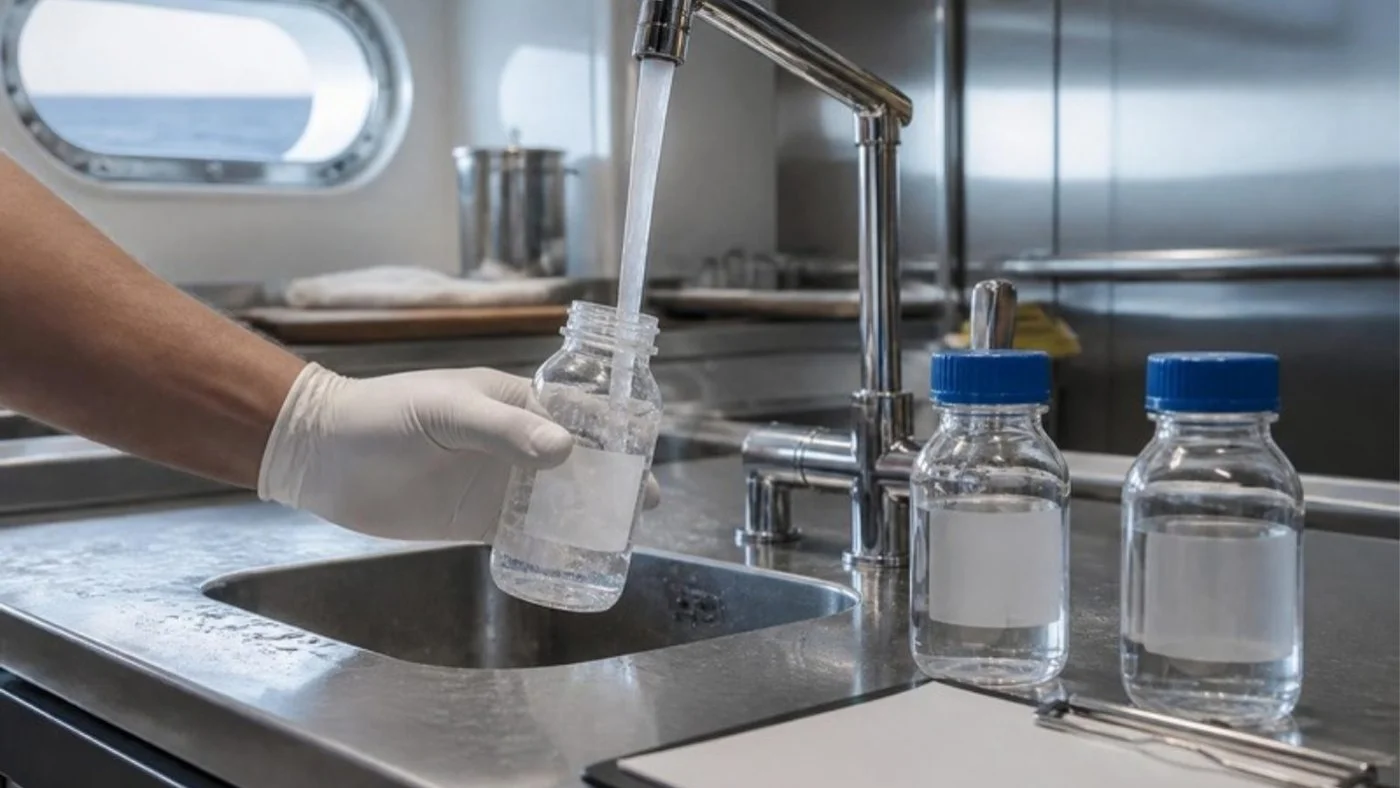

A lab number without the place, the date and the readings next to it is hard to use. We write all of it down, so the next test can be compared with this one.
Francesco Colombo
CEO · AirBio Marine, a division of AirBio (Ekonore S.r.l.)
Book a water testVerified reviews on Trustpilot
What we do
We take sterile samples at the points the yacht’s plan calls for, record the on-board readings and send the bottles to a laboratory. You receive one report with the readings, the sample points and the results.
If a tank needs work first, see the tank inspection guide.

How we sample yacht drinking water, step by step
Five steps, agreed with the crew.
Plan the points
Tank, distribution line and far outlets are chosen with the crew.
Read on board
Chlorine, pH and temperature are read and written down.
Sample
Sterile bottles are filled at each point without touching the neck.
Send
Bottles go to a laboratory the same day.
Report
Results are read with the crew and filed with the readings.
Testing is only useful if someone acts on the result. We tell the crew what we saw, in plain words.
Francesco Colombo
CEO · AirBio Marine, a division of AirBio (Ekonore S.r.l.)
Speak to our teamA sample routine
A starting point built on the WHO guide. Adjust it to the vessel.
- Every fill: check the chlorine level of incoming water.
- Regularly: read chlorine, pH and temperature at the far outlets.
- At planned intervals: send samples for E. coli and plate count.
- After any repair or contamination: clean, disinfect, flush, then sample again.
- Always: record the point, date and reading.
Warning signs
- Water that is cloudy or has a smell, colour or taste you did not notice before.
- Chlorine that drops between the tank and the far outlets.
- A tank that has been opened, repaired or left partly empty.
- A result with no sample point or date written next to it.
See also cloudy water and tank contamination.
FAQ
What should be found in a drinking-water sample?
The WHO guide says no E. coli or thermotolerant (faecal) coliforms should be detected in any 100 ml sample.
What chlorine level should there be?
At least 0.2 mg/l of free chlorine at the point of delivery. A satisfactory level at the entry to the system is typically around 0.5–1 mg/l.
How long does a laboratory test take?
Microbiological analysis typically takes about 18 to 24 hours, according to the guide.
How many samples should I take?
The guide does not give a fixed number. Agree the schedule with the yacht’s management, class or charter requirements.
Where should samples be taken?
From the port supply, the distribution system, including the far outlets, and the tanks through their sample cocks.
Is a home test kit enough?
Quick kits help for chlorine, pH and temperature. Bacteria such as E. coli need a laboratory.
Sources
- World Health Organization — Guide to Ship Sanitation, chapter 2: Water (3rd edition, 2011): E. coli, chlorine, pH, temperature, sampling points and analysis time.
Want your drinking water tested properly?
We take sterile samples, read the on-board values and send a laboratory report.
Speak to a marine technicianRelated on AirBio Marine
Ready to test your yacht’s water?
Sampling, laboratory analysis and a clear report, at the berth.
Verified reviews on Trustpilot
Tell us about the yacht
Yacht length, marina, systems and what you have noticed on board. A technician reads the message and calls you back to plan the survey.
"*" indicates required fields
Where we work
Italian Riviera and Tuscany marinas and yards — Viareggio, La Spezia, Portofino, Genoa, Sanremo, Livorno, Argentario — and other Mediterranean ports on request.
Documented work
Every job ends with a technical report and photos for the yacht's records.