
Yacht Hot Water and Legionella: Which Temperatures Matter?
Legionella grows in warm water and struggles in hot and cold. Here are the temperatures that WHO, CDC and the UK HSE give, and what they mean for a yacht’s calorifier and taps.
Legionella grows in water between about 20°C and 50°C. WHO advises keeping hot water above 50°C, which means leaving the heater at 60°C or more, and cold water below 25°C. The WHO ship guide asks for hot water to leave the calorifier at 60°C and return at no less than 50°C.
Why temperature matters
Legionella bacteria are common in water. They become a problem when water sits warm for long enough to let them multiply, and when droplets, such as shower spray, are breathed in.
On a yacht, warm spots are easy to create: a calorifier that runs too cool, a hot line that never circulates, a cold line that runs next to an engine room wall, or a cabin tap that is rarely used. Temperature is the simplest control, and it costs nothing to check. For the wider picture, see our guide to Legionella on yachts.
What the guidance says
The only source written for ships is the WHO Guide to Ship Sanitation. The others below are written for buildings, so use them as a model and adapt them to the yacht’s own water plan.
- WHO Guide to Ship Sanitation (ships): cold water stored below 25°C. Hot water leaves the calorifier at 60°C or more, and returning water is no colder than 50°C. Showerheads are cleaned and disinfected every six months.
- WHO Legionellosis fact sheet (general): Legionella grows at 20–50°C, best at 35°C. Keep hot water above 50°C, which needs 60°C or more leaving the heater, and cold water below 25°C, ideally below 20°C. Flush unused taps weekly.
- US CDC (buildings): store hot water above 140°F (60°C) and keep circulating hot water at 120°F (49°C) or more. Growth is favoured at 77–113°F (25–45°C).
- UK HSE (buildings): hot outlets should reach at least 50°C within a minute of running, and cold outlets should be below 20°C after two minutes.
The sources differ slightly. The safe way to read them is to use the ship guide’s figures where a yacht is covered by it and check your own flag, class and water plan.
Four numbers to know
From the WHO ship guide and WHO, CDC and HSE building guidance.
Not sure what your calorifier is doing?
Tell us about the system. We will suggest which temperatures to read first.
The key numbers
Think of the water system in three bands. Cold and hot are the safe ends. The warm middle is where the bacteria multiply.
Very hot water can scald. That is why buildings use thermostatic mixing valves close to the outlet, which the HSE says should still deliver at least 50°C within a minute. A qualified technician should set these.
What to check on board
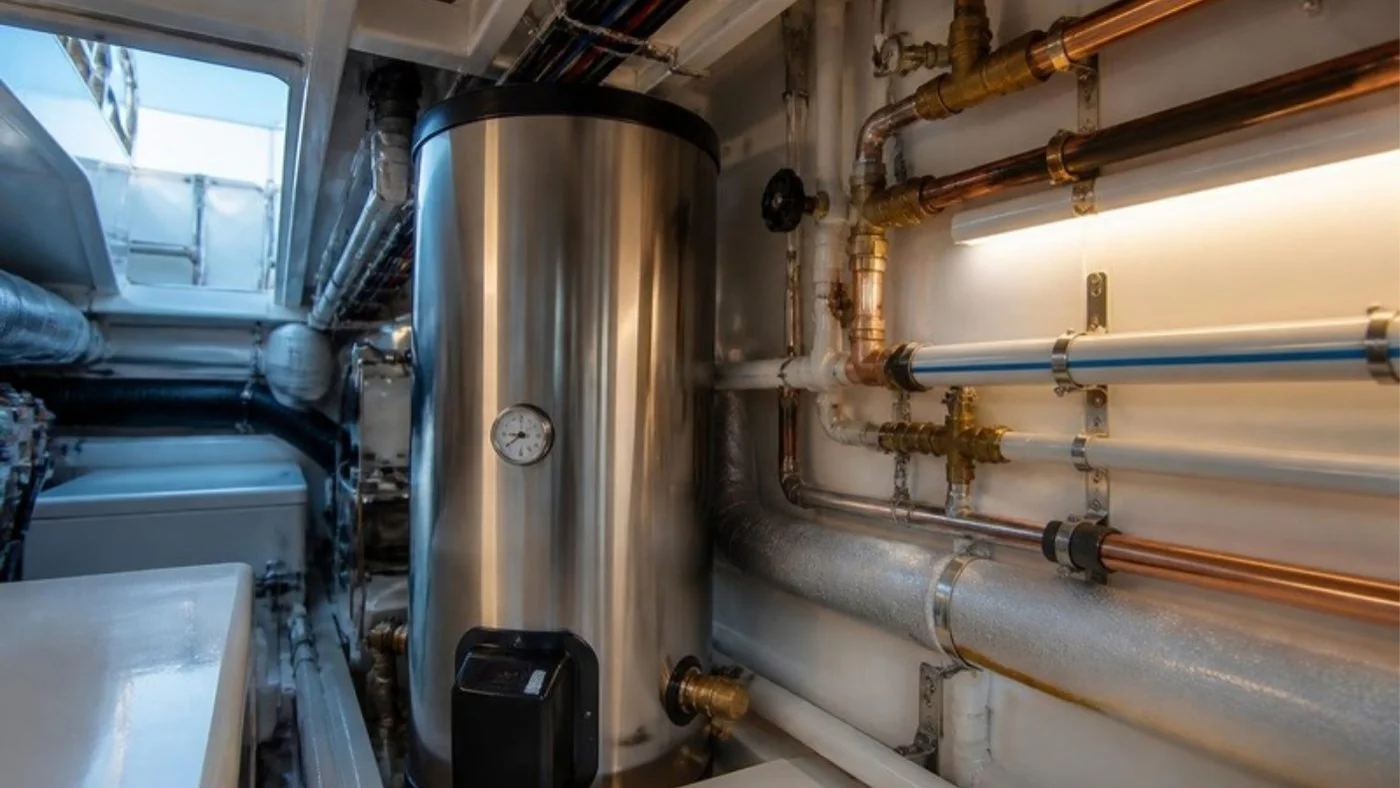
Calorifier. Check the set temperature and the temperature of the water leaving it. Ask when it was last drained and cleaned.
Return line. The circulation return should not be colder than 50°C. A cold return means part of the loop is not circulating.
Cold water. Cold lines and tanks should stay below 25°C, ideally below 20°C. Check lines near engine rooms and hot pipes.
Rarely used taps. Cabins that are shut for weeks hold still water. The WHO fact sheet suggests flushing unused taps weekly.
Showerheads. Clean and disinfect them every six months.

A thermometer tells you more than most people expect. The trouble is that nobody writes the number down. We read it at the heater, at the return and at the furthest tap, and we keep the record.
Francesco Colombo
CEO · AirBio Marine, a division of AirBio (Ekonore S.r.l.)
Book a water-system surveyVerified reviews on Trustpilot
What we do
We survey the hot and cold lines, read temperatures at the calorifier, the return and the far outlets, and take samples for Legionella when needed. If the result is positive we treat the whole system, not only the tap.
See our Legionella testing and Legionella remediation services.

How we check a yacht’s hot water, step by step
Five steps, done at the berth.
Map the system
Calorifier, loop, cold lines and outlets are traced with the crew.
Read temperatures
Heater, return and far outlets are measured and written down.
Find dead ends
Unused taps and lines that do not circulate are marked.
Sample if needed
Samples for Legionella go to an accredited laboratory.
Report
Readings, findings and next steps go into the yacht’s file.
When one tap is warm and the rest are hot, that tap is where we start looking.
Francesco Colombo
CEO · AirBio Marine, a division of AirBio (Ekonore S.r.l.)
Speak to our teamA sample routine
A starting point based on the guidance above. Adjust it to the vessel.
- Weekly: run unused taps for a few minutes.
- Regularly: read calorifier, return and far outlet temperatures, and write them down.
- Every six months: clean and disinfect showerheads.
- At every dock or two years: inspect and clean tanks.
- After a repair or a long layup: flush, and consider a Legionella sample.
Warning signs
- Hot water that takes a long time to get hot, or never gets properly hot.
- A return line that feels cool.
- Cabins that have been shut for weeks with the taps unused.
- No written temperature records.
See our page on Legionella found on board if you already have a positive result.
FAQ
What temperature should yacht hot water be?
The WHO ship guide says hot water should leave the calorifier at 60°C or more, and returning water should be no colder than 50°C.
What temperature should cold water be?
The WHO ship guide says below 25°C. The WHO fact sheet says ideally below 20°C.
At what temperature does Legionella grow?
The WHO fact sheet gives 20 to 50°C, with the best growth around 35°C.
Is hot water at 60°C safe to use at the tap?
No. It can scald. Buildings use thermostatic mixing valves near the outlet. The HSE says these should still deliver at least 50°C within a minute. A qualified technician should set them.
How often should unused taps be flushed?
The WHO fact sheet suggests weekly.
Do the CDC and HSE figures apply to yachts?
They are written for buildings. Use them as a model and check the yacht’s own water plan, flag and class.
Sources
- World Health Organization — Guide to Ship Sanitation, chapter 2: Water (2011): calorifier, return and cold-water temperatures, showerheads.
- World Health Organization — Legionellosis fact sheet (2022): growth range, hot and cold temperatures, weekly flushing.
- US CDC — Controlling Legionella in Potable Water Systems (2025): hot water storage and circulation temperatures (written for buildings).
- UK Health and Safety Executive — Hot and cold water systems: things to consider (written for buildings).
Want your hot water system checked?
We read temperatures, take samples if needed and write a report for the yacht’s file.
Speak to a marine technicianRelated on AirBio Marine
Ready to check your hot water?
Temperatures, samples and a written report, at the berth.
Verified reviews on Trustpilot
Tell us about the yacht
Yacht length, marina, systems and what you have noticed on board. A technician reads the message and calls you back to plan the survey.
"*" indicates required fields
Where we work
Italian Riviera and Tuscany marinas and yards — Viareggio, La Spezia, Portofino, Genoa, Sanremo, Livorno, Argentario — and other Mediterranean ports on request.
Documented work
Every job ends with a technical report and photos for the yacht's records.