

Positive Legionella Result on a Yacht: What Happens Next?
A positive result is a reason to act, not to panic. Here is the order the CDC suggests, and what the WHO ship guide adds for contaminated water.
The US CDC says there is no known safe level of Legionella, so any positive result should start a response. It suggests checking the sampling and testing first, then the equipment and records, then the control plan, and only then treatment. After the system is back to normal, samples are taken again, at least 48 hours later.
What a positive result means
A positive Legionella result means the bacteria were found in the sample, at that place and time. It does not say anyone is ill, and it does not say the whole system is contaminated. It does say the water is not being controlled as well as it should.
The right response is calm and in order. Treating only the tap where the sample was taken may leave the cause in place. For background on why, see our guide to Legionella on yachts.
What the guidance says
The US CDC’s routine testing guidance is written for buildings, not yachts. The WHO guide is written for ships but is not a Legionella protocol. Use both as a model and follow the yacht’s own water plan, class and flag rules.
- No known safe level: the CDC says no safe level of Legionella is known, so any positive result should prompt a response. In hot tubs and spa pools, any living Legionella warrants an immediate response.
- Check first, treat later: the CDC lists, in order, a review of sampling, handling and testing errors, a check that equipment works, a review of the water management records, a re-evaluation of assumptions, and adjusting the plan. Remedial treatment is considered after that.
- Re-test: representative samples are taken again at least 48 hours after the system returns to normal operation.
- Contaminated tank or water (WHO ship guide): for suspected contamination, one procedure is to reach around 20 mg/l chlorine after 1 hour of contact. After a tank repair or contamination, free halogen is raised to at least 50 mg/l in the affected area for 4 hours, then the tank is flushed.
Which action fits a given result depends on the numbers, the place and the system. It should be decided by a qualified technician with the yacht’s plan, not from a fixed table.
Four points to remember
From the US CDC routine testing guidance and the WHO Guide to Ship Sanitation.
Just got a positive Legionella result?
Send it to us. We will tell you what it means and what to do first.
The order of steps
Whatever the numbers, the order stays the same: understand, correct, treat, prove.
Treating first and asking questions later can hide the cause. The bacteria can return if the reason they grew, such as a cool return line or a dead-end pipe, is still there.
What to check on board
The result itself. Was the sample taken and handled properly? Which point was it? What was the temperature there?
Temperatures. Calorifier, return and far outlets. See our guide to hot water temperatures.
Dead ends and unused outlets. Lines that hold still water are common causes.
Records. When were the tanks, calorifier and showerheads last cleaned? Showerheads should be cleaned and disinfected every six months, per the WHO ship guide.
Tanks. If a tank is a suspect, see the tank inspection guide.
A positive result feels heavy on board, but it is information you can use. Our job is to find why the bacteria grew, and to show the captain with a second test that the cause is gone.
Francesco Colombo
CEO · AirBio Marine, a division of AirBio (Ekonore S.r.l.)
Talk to a technicianVerified reviews on Trustpilot
What we do
We review the result and the records, survey the whole system, treat it, and take clearance samples. You receive a report that names the cause we found and what we changed.
See our Legionella remediation and testing services, and the page on Legionella found on board.
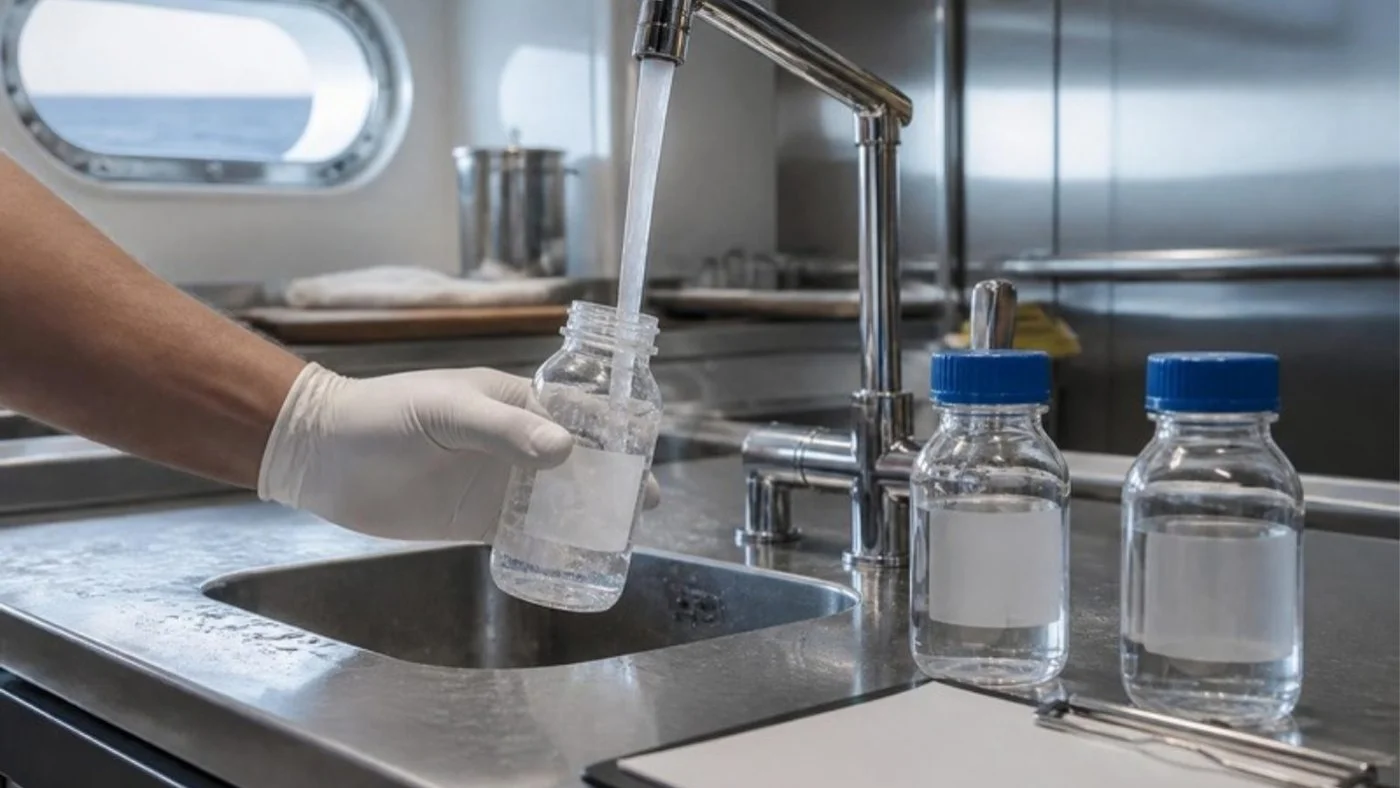
How we handle a positive result, step by step
Five steps, agreed with the captain.
Review
We read the result, the sample point and the yacht’s records.
Survey
We trace the system and find warm spots, dead ends and unused outlets.
Correct
Temperatures, circulation and any faulty parts are fixed first.
Treat
The whole system is treated, not only the tap.
Clear
New samples are taken after the system is back to normal, and the report is filed.
We keep the language simple: what we found, what we changed, and what the next sample shows.
Francesco Colombo
CEO · AirBio Marine, a division of AirBio (Ekonore S.r.l.)
Speak to our teamA sample routine
A starting point built on the CDC order. Adjust it to the vessel.
- Same day: inform the captain and the yacht manager, and write down what was found and where.
- First days: check the sample, temperatures, records and dead ends.
- Then: correct the cause and treat the system.
- At least 48 hours after normal operation: take new samples from the same points.
- After: keep testing on a schedule and keep the records.
Warning signs
- A positive result with no follow-up sample.
- Only one tap treated.
- Hot water that still does not get hot.
- A positive result that returns after treatment.
See our page on Legionella found on board.
FAQ
Is any Legionella result a problem?
The US CDC says no safe level of Legionella is known, so any positive result should prompt a response.
What should be done first after a positive result?
Check the sampling and testing for errors, then equipment and records, then the control plan. Treatment comes after that, according to the CDC order.
When should I re-test?
The CDC suggests taking representative samples at least 48 hours after the system returns to normal operation.
Is it enough to treat the tap that tested positive?
No. The cause is usually in the system, such as a cool return line or a dead end, so the whole system is reviewed and treated.
What does the WHO ship guide say about contaminated water?
For suspected contamination it gives a procedure of around 20 mg/l chlorine after 1 hour. After tank repair or contamination, it gives at least 50 mg/l free halogen for 4 hours, then flushing.
Do the CDC guidelines apply to yachts?
They are written for buildings. Use them as a model, and follow the yacht’s own water plan, flag and class rules.
Sources
- US CDC — Routine Testing for Legionella (2025): no known safe level, order of response, re-testing (written for buildings).
- World Health Organization — Guide to Ship Sanitation, chapter 2: Water (2011): chlorine for suspected contamination, tank disinfection, showerheads.
Have a positive result on board?
We review it, survey the system, treat it and prove the result with new samples.
Speak to a marine technicianRelated on AirBio Marine
Ready to fix it and prove it?
Treatment, clearance samples and a written report, at the berth.
Verified reviews on Trustpilot
Tell us about the yacht
Yacht length, marina, systems and what you have noticed on board. A technician reads the message and calls you back to plan the survey.
"*" indicates required fields
Where we work
Italian Riviera and Tuscany marinas and yards — Viareggio, La Spezia, Portofino, Genoa, Sanremo, Livorno, Argentario — and other Mediterranean ports on request.
Documented work
Every job ends with a technical report and photos for the yacht's records.