
Legionella on Yachts: How It Grows, How It’s Tested and How to Control It
A practical, source-based guide for captains, chief engineers and yacht managers: where Legionella develops in a yacht’s fresh-water system, how it is tested, and the temperature and flushing rules that keep it under control.
Legionella is a waterborne bacterium that can grow in any warm, still fresh-water system — and a yacht, with its tanks, long pipe runs, calorifiers, showers and spa, is close to an ideal environment. The good news is that the risk is manageable: it comes down to temperature, movement and testing. This guide explains how the bacterium behaves, why yachts are exposed, and the concrete steps that keep a vessel’s water safe.
What Legionella is, and why it matters
Legionella is a group of bacteria found naturally in fresh water. In building and boat water systems it can multiply to numbers that cause disease. Inhaling contaminated aerosols — the fine spray from a shower, tap or spa — can cause Legionnaires’ disease, a serious and potentially fatal form of pneumonia with an incubation period the World Health Organization gives as 2 to 10 days, and a milder flu-like form called Pontiac fever. The bacterium is not passed from person to person; the route onto a yacht is the water system itself.
Why a yacht is especially exposed
A yacht combines several of the conditions Legionella needs. Water sits in tanks and long distribution lines; the Mediterranean keeps those lines warm; and use is intermittent — a guest cabin or a crew shower can go untouched for weeks between charters or over a winter lay-up. Warmth plus stagnation is exactly what lets the bacterium build up, which is why the highest-risk moments are recommissioning after lay-up and the start of the season. This is different from a house or a hotel, where water moves every day; on a yacht the pattern of use is the problem.
The numbers that keep water safe
These figures come from World Health Organization guidance. Control comes down to keeping water out of the range where the bacterium grows.
Not sure where your water system stands?
Tell us about the vessel and the berth. We will suggest sampling points and the right test, at your port.
The temperature danger zone
In short: Legionella grows in water between roughly 20 and 50°C, with the fastest growth around 35°C. Below and above that band it does not proliferate. The whole of Legionella control is built on keeping water out of that range — cold water genuinely cold, hot water genuinely hot.
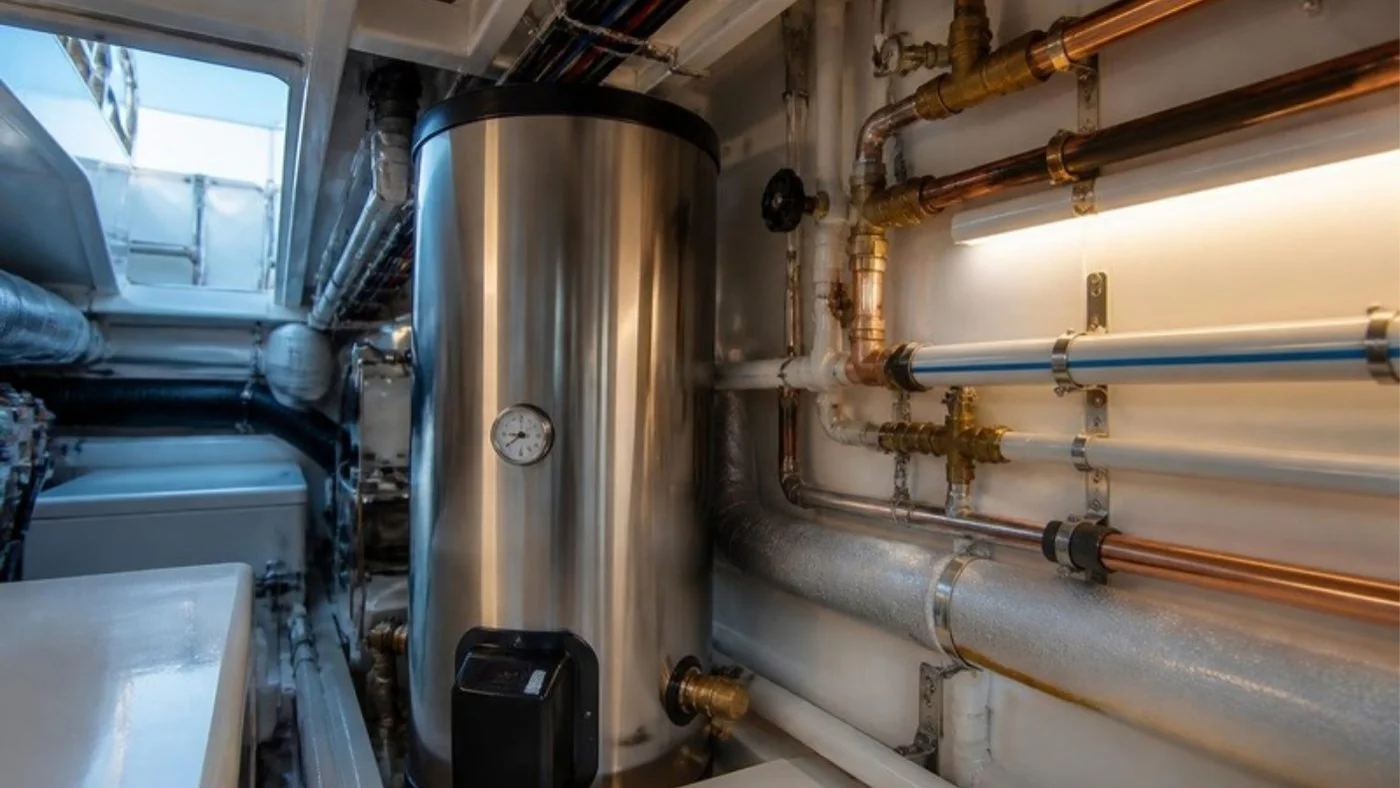
The WHO Guide to Ship Sanitation sets the working figures for a vessel: hot water should leave the calorifier at at least 60°C, and where a circulation loop is used the returning water should not fall below 50°C; cold potable water should be kept below 25°C throughout the system. On many yachts the cold line runs alongside warm machinery, so “cold” water is not always cold — that is one of the first things a survey checks.
Where the risk concentrates on board
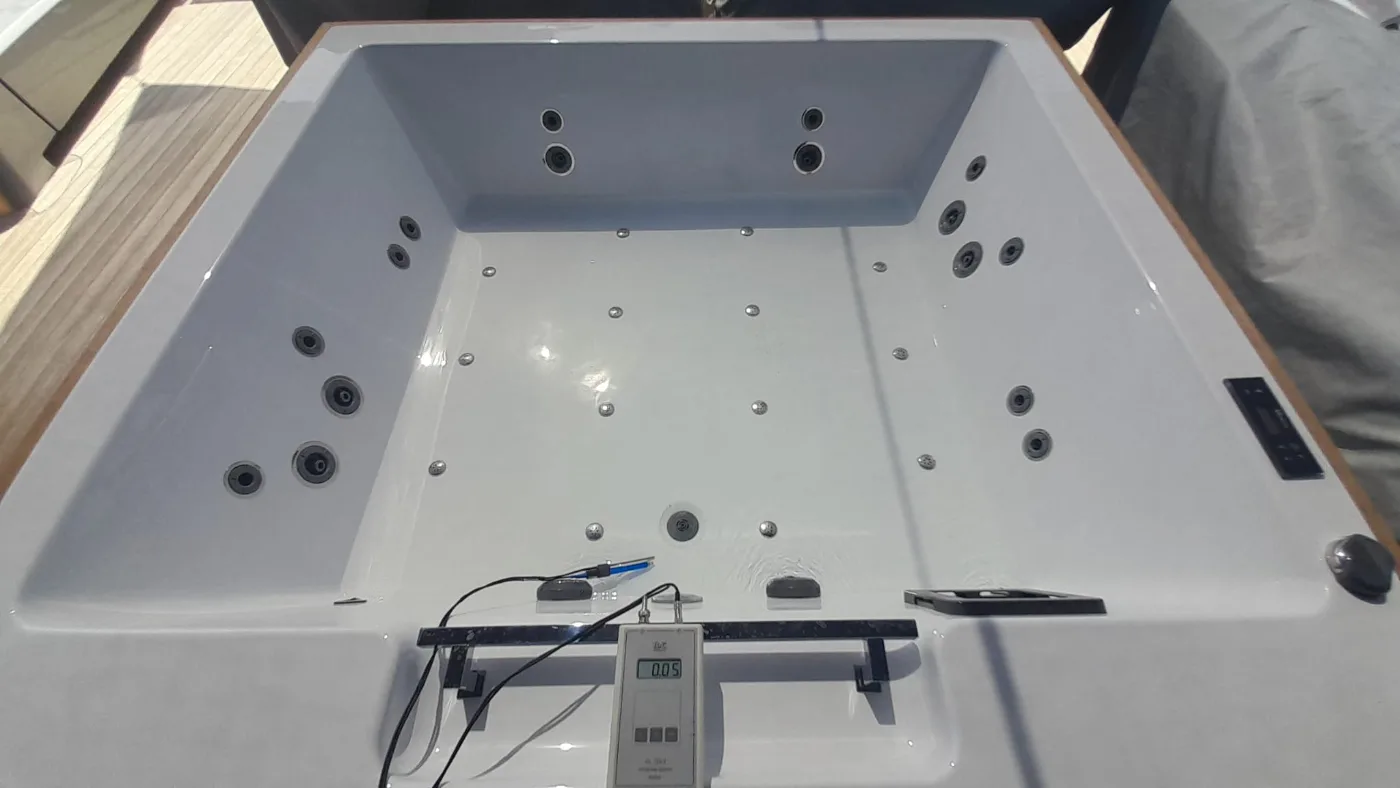
Contamination is rarely spread evenly. It gathers where water is warm and still: the calorifier and hot-water lines, the fresh-water tanks, dead legs and seldom-used outlets, and anywhere fine spray is produced — showerheads, taps and the spa or jacuzzi. Showerheads and aerators in particular can hold high bacterial numbers; WHO guidance is to clean and disinfect showerheads every six months. A survey follows the water from tank to outlet and identifies these points before deciding what to sample and treat.

On a yacht the water system changes every time the vessel moves, fills or sits at the berth. That is why we start every job with a survey of the system, not with a product.
Francesco Colombo
CEO · AirBio Marine, a division of AirBio (Ekonore S.r.l.)
Book a water-system surveyVerified reviews on Trustpilot
How Legionella is tested on a yacht
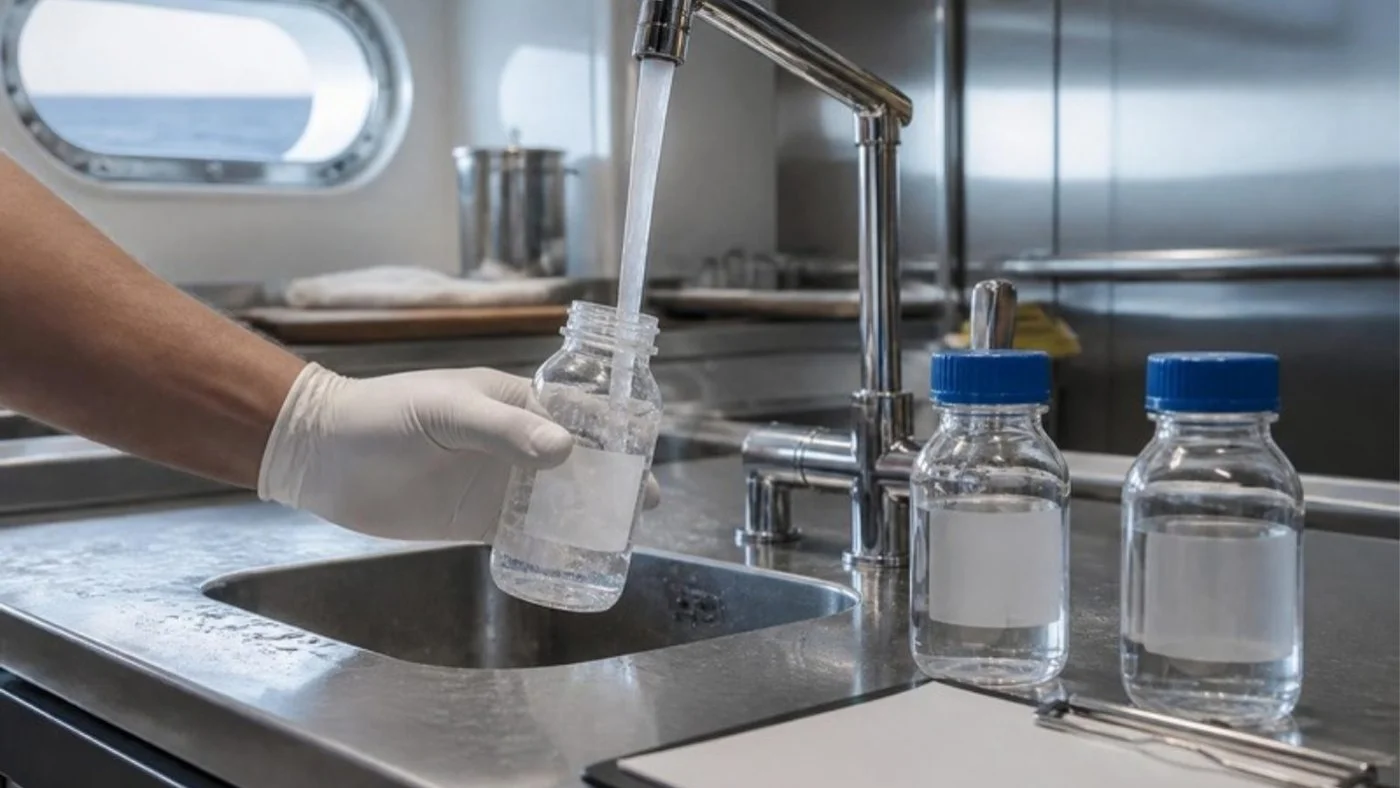
Can Legionella be tested without moving the yacht? Yes. Sampling is done at the berth. Water samples are collected from representative outlets — typically the tank, the calorifier and a selection of showers and taps — and analysed by an accredited laboratory. The reference method is culture to ISO 11731, which grows and counts any Legionella present and reports the result in colony-forming units per litre (CFU/L). Culture takes several days because the bacteria are slow-growing; the value of the method is that it quantifies the problem rather than simply flagging it.
Related pages: Legionella testing for yachts · water sampling.
From survey to clearance, at the berth
Legionella work on a yacht follows the same five steps, planned around the vessel’s programme — no yard move needed.
Survey
A technician follows the water from tank to outlet and identifies the points that matter.
Sampling
Water is collected from the tank, the calorifier and representative showers and taps.
Laboratory
Samples are analysed by culture to ISO 11731 and counted in CFU per litre.
Treatment
If needed, the system is disinfected thermally and/or chemically, then flushed.
Clearance
A follow-up sample confirms the result, with a written report for the vessel’s records.
We want the captain and the chief engineer to end up with a clear laboratory report and a routine the crew can really follow. Testing shows where you stand; prevention keeps you there.
Francesco Colombo
CEO · AirBio Marine, a division of AirBio (Ekonore S.r.l.)
Speak to our teamWhat to do after a positive result
A positive result is a management task, not an emergency to hide. The system is treated and then re-tested to confirm the treatment worked. Two routes are used, often together: thermal disinfection — raising and flushing the system at high temperature — and chemical shock disinfection. For chemical treatment after contamination, the WHO Guide to Ship Sanitation describes raising free residual halogen to at least 50 mg/L across the affected area and holding it for four hours, after which the system is flushed and returned to a normal residual. The work is documented, and a clearance sample closes it out.
Related pages: Legionella remediation · water-system sanitization · fresh-water tank sanitization.
A prevention checklist for yacht water systems
- Keep temperatures right: hot water leaving the calorifier at 60°C or above; cold water below 25°C throughout.
- Move the water: flush seldom-used showers and taps for a few minutes on a set schedule, especially guest cabins between charters.
- Clean spray points: descale and disinfect showerheads and aerators about every six months.
- Service the tanks: inspect, clean and disinfect fresh-water tanks periodically — the ship-sanitation benchmark is at each dry/wet dock or every two years, whichever comes first.
- Recommission carefully: after any lay-up, sanitize and sample before the vessel is used, not after guests are aboard.
- Test and keep records: a simple sampling programme and a written result give the captain and manager something to file and to show.
Frequently asked questions
Can Legionella grow in a yacht’s fresh-water tank?
Yes. A tank that holds warm, still water for long periods is a favourable environment, which is why tanks are a standard sampling and cleaning point. Keeping stored cold water below 25°C and servicing the tank on a schedule are the main controls.
How often should a yacht’s water system be tested?
There is no single legal figure for private yachts, but testing is most valuable before the season and after any lay-up or refit, and as part of a routine sampling programme through the year. Any change in taste, smell or clarity of the water is a reason to test sooner — see water that smells and cloudy water.
Does the yacht have to go to a yard for this?
No. Sampling, treatment and re-testing are carried out at the berth, planned around the vessel’s programme.
Sources
- World Health Organization — Legionellosis fact sheet (growth temperatures, transmission, incubation, control measures).
- World Health Organization — Guide to Ship Sanitation, Water chapter (calorifier and cold-water temperatures, tank inspection, shock disinfection).
- ISO 11731 — Water quality: enumeration of Legionella (laboratory reference method).
Concerned about the water on your yacht?
We sample, treat and re-test at the berth, and give you the laboratory report for the vessel’s records.
Speak to a water-system specialistRelated on AirBio Marine
Ready to test or treat your yacht’s water system?
Sampling, ISO 11731 laboratory analysis and, if needed, treatment and clearance — all at your berth.
Verified reviews on Trustpilot
Tell us about the yacht
Yacht length, marina, systems and what you have noticed on board. A technician reads the message and calls you back to plan the survey.
"*" indicates required fields
Where we work
Italian Riviera and Tuscany marinas and yards — Viareggio, La Spezia, Portofino, Genoa, Sanremo, Livorno, Argentario — and other Mediterranean ports on request.
Documented work
Every job ends with a technical report and photos for the yacht's records.