
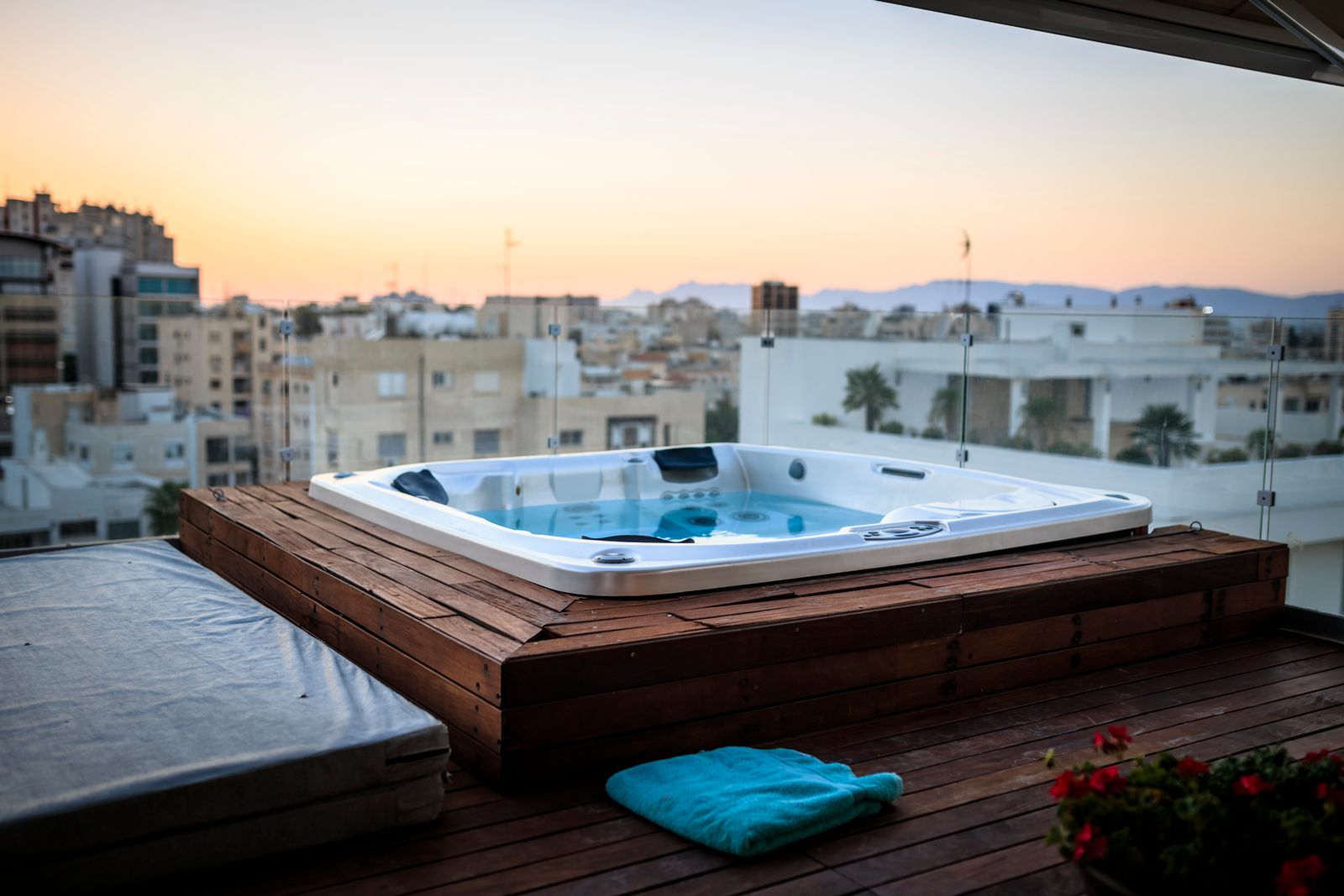
Yacht Jacuzzis, Spa Pools and Showers: Why Mist Matters
Jets and showers turn water into mist, and mist is how Legionella reaches the lungs. Here are the figures WHO and CDC give for spas, and a routine for showers.
Scientific review by Linda Abenaim, Biologist ·
The WHO Guide to Ship Sanitation asks for whirlpool spas to keep a free chlorine residual of typically 3 to 10 mg/l, a pH of typically 7.2 to 7.8, a temperature that cannot go above 40 °C, and regular draining and cleaning of surfaces and pipework. Showerheads should be cleaned and disinfected every six months.
Why mist matters
A jacuzzi and a shower have one thing in common: they throw fine droplets into the air. If Legionella is in the water, those droplets can be breathed in. That is the way people get Legionnaires’ disease, as we explain in our article on what public-health bodies say.
A warm spa is also about the right temperature for the bacteria, and the jets and hot water use up disinfectant faster. So a spa needs more attention than a tank, not less.
What the guidance says
The WHO Guide to Ship Sanitation (2011) is written for ships. The CDC hot tub guidance is written for buildings. Use the second as a cross-check, not as a ship rule.
- WHO ship guide, disinfectant: free chlorine typically 3 to 10 mg/l, or free bromine typically 4 to 10 mg/l.
- WHO ship guide, pH: typically 7.2 to 7.8.
- WHO ship guide, temperature: a control must stop the water going above 40 °C.
- WHO ship guide, water and cleaning: replace a portion of the water each day, for example 50%, and regularly drain completely and physically clean all surfaces and pipework.
- WHO ship guide, air: rooms with spas must be well ventilated.
- CDC (buildings): hot tubs sit in the temperature range that suits Legionella, 25 to 45 °C, and make aerosols. It asks for disinfectant and pH checks at least twice a day, and the same care for a tub that is filled but not in use.
The key figures for a yacht spa
From the WHO Guide to Ship Sanitation (ships) and CDC (buildings).
Unsure when your spa was last drained and tested?
Tell us about the spa and showers. We will suggest a routine.
The key figures
Two sources, two audiences. The figures are close but not the same: the CDC lists bromine at 4 to 8 ppm, the WHO ship guide at 4 to 10 mg/l. Rather than picking a number from one page, follow the manufacturer’s instructions and the limits in your yacht’s own water plan, and keep the readings on record.
The WHO ship guide also says Legionella should be tested for periodically, for example monthly, quarterly or yearly, depending on the type of ship environment.
 Biologist
Linda Abenaim, Biologist at Ekonore / AirBio
A spa pool is warm, aerated and shared by several people, which makes it one of the easiest places on board for bacteria to grow. The jets turn the water into a fine spray right at face height, so hygiene there matters more than almost anywhere else.
Linda Abenaim · Biologist, Ekonore / AirBio
If the spa has been off for a while, have it cleaned and disinfected before the first guest uses it again.
- Warm waterideal for growth
- Jetsspray at face height
- Filtershold organic dirt
What to check on a yacht
Spa water. Is disinfectant and pH tested and logged, including when the spa is filled but not used?
Draining. When was the spa last drained completely and the pipework cleaned?
Showerheads. Are they cleaned and disinfected every six months? Aerators can also hold very high numbers of bacteria, according to the WHO ship guide.
Dead ends. The WHO guide says dead ends in the pipework should be kept to a minimum.
Seldom-used fittings. Flush them for a few minutes regularly. See our hot water guide.

A jacuzzi is the part of the yacht guests love and the part nobody wants to check. We check it.
Francesco Colombo
CEO · AirBio Marine, a division of AirBio (Ekonore S.r.l.)
Book a spa and shower checkVerified reviews on Trustpilot
Reviews of La BioDisinfestazione | Ekonore Italia, the group AirBio Marine belongs to.
What we do
We inspect the spa, showers and fittings, take water samples for the laboratory, and clean and disinfect what needs it. We then test again and report the results.
See our Legionella testing and water system sanitization services.
How we check spas and showers, step by step
Five steps, planned with the crew.
Inspect
We look at the spa, showers, aerators and dead ends.
Measure
We check temperature, disinfectant and pH on site.
Sample
Samples are taken and sent to a laboratory.
Clean
Fittings are cleaned and disinfected where needed.
Report
You receive readings, lab results and photos.
We measure on site, sample for the laboratory and write down what we found, so the crew has a record to follow.
Francesco Colombo
CEO · AirBio Marine, a division of AirBio (Ekonore S.r.l.)
Speak to our teamA sample routine
A starting point built on the WHO ship guide and CDC. Adjust it to the yacht and to the spa maker’s instructions.
- Each use or each day: test disinfectant and pH and log them. Replace part of the spa water daily, as the WHO ship guide suggests.
- Regularly: drain the spa completely and clean all surfaces and pipework.
- Weekly or as the plan says: flush seldom-used showers and taps for a few minutes.
- Every six months: clean and disinfect showerheads.
- At planned intervals: test for Legionella. The WHO ship guide says monthly, quarterly or yearly, depending on the environment.
- Always: keep readings and lab reports on file.
Warning signs
- Cloudy or smelly spa water.
- A spa left full and untreated between trips.
- Showerheads with scale or slime.
- No log of disinfectant and pH readings.
See also cloudy yacht water and Legionella testing and ISO 11731.
FAQ
What disinfectant level should a yacht spa have?
The WHO Guide to Ship Sanitation gives typical ranges of 3 to 10 mg/l free chlorine or 4 to 10 mg/l free bromine, with pH typically 7.2 to 7.8. Follow the maker’s instructions and your water plan too.
How often should a yacht spa be drained?
The WHO ship guide says to replace a portion of the water daily, for example 50%, and to drain completely and clean surfaces and pipework regularly. It does not give one fixed interval for the full drain.
What is the maximum spa temperature?
The WHO ship guide says the temperature control must stop the water going above 40 °C.
How often should showerheads be cleaned?
Every six months, according to the WHO Guide to Ship Sanitation.
Does an unused spa still need care?
The CDC says a hot tub that holds water, even for display, needs the same disinfectant and pH checks as one in use.
Do CDC figures apply to yachts?
The CDC page is written for buildings. Use it as a cross-check, and use the WHO ship guide and the maker’s instructions first.
Sources
- World Health Organization — Guide to Ship Sanitation, 3rd edition (2011): whirlpool spas and spa pools.
- World Health Organization — Guide to Ship Sanitation (2011): water chapter, showerheads, aerators, dead ends.
- US Centers for Disease Control and Prevention — Controlling Legionella in Hot Tubs (updated January 2025): written for buildings.
Not sure your jacuzzi and showers are safe?
We measure, sample and clean, and show you the results.
Speak to a marine technicianRelated on AirBio Marine
Ready to check your spa and showers?
Measurements, sampling, cleaning and a written report, at the berth.
Verified reviews on Trustpilot
Reviews of La BioDisinfestazione | Ekonore Italia, the group AirBio Marine belongs to.
Tell us about the yacht
Yacht length, marina, systems and what you have noticed on board. A technician reads the message and calls you back to plan the survey.
"*" indicates required fields
Where we work
Italian Riviera and Tuscany marinas and yards — Viareggio, La Spezia, Portofino, Genoa, Sanremo, Livorno, Argentario — and other Mediterranean ports on request.
Documented work
Every job ends with a technical report and photos for the yacht's records.